
ISSUE 8.3
SUMMER 2021
welcome
issue contents
> poetry
> fiction
> nonfiction
contributors
interviews
featured art
our editors
Carling Ramsdell
Whistling Whirlwinds, Unfurling Flowers
After my first day of tenth grade, my older sister, Elodie, swings open the door of our sunken house and immediately gags. She clamps her hand over her mouth and nose as a corpse flower unfurls, its petals opening like an umbrella and pressing against the walls of the kitchen. The smell of death fills the room. The yellow stalk punches a hole through the ceiling. I push back the purple flaps of the petals to find my parents amongst the rusted pots and the shattered plates. They have turned into snakes, but I still know them. I pick up their cool, slim bodies in my hands. As I carry them up the creaking stairs, they curl around my fingers, tongues poking against my palms. I put them in Fettuccine’s old cage on my nightstand and leave the top off. I sit on my bed and pull out the flute I play in band class. As I hum into it, fingers dancing, my parents, now Dustin and Silvia—as Mom and Dad seem like strange names for snakes—slide from the cage and drop down onto the wooden floorboards. They twist around the rusted metal bed frame and sway, black eyes focused on me.
I can hear Elodie downstairs yelling for me, but I concentrate on the twisting music swimming circles around Dustin and Silvia. Usually, snake charming is my favorite hobby. I attract garter and milk snakes into the garden in droves. They swarm over each other in rippling streams. I like the way their heads tilt, the way their tongues flick out of their mouths, but with Dustin and Silvia, everything feels off. When they tilt their heads, they do not look innocent and curious. They look like snakes. I stop halfway through the song, and my parents thread their way back into the cage.
I lie back on my cream bedspread, but I’m floating above it.
Fettuccine was my first snake. I found her in the overgrown field behind my house when I was nine. I played the songs I was learning in music class on the recorder for her. She rose from the ground and swayed towards me, but didn’t strike. Instead, she rested her head on my knee and flicked her tongue against my skin. She was a rattlesnake, and I knew that, but I also assumed I knew enough about rattlesnakes to keep one. I showed her to Dustin and Silvia, then still my parents. They bought me a terrarium to put her in, not giving much thought to the shape of her head, her cat-like pupils, and the pattern of brown splotches along her body. The next morning, I put her in my bag to take to school.
We were going over the week’s spelling words. My bag was poking out from under my desk, just a little bit. I’d unzipped a round hole in the top so Fettuccine could breathe. That’s when Kirsten Crabtree slid past my desk and nudged my bag with her toe by mistake. I disappeared as Fettuccine sprung out. She hissed, a menacing gurgle, and sunk her teeth into Kirsten’s ankle. Kirsten took a shaking step backward and fell onto her hands. She shrieked, piercing. It shook the ceiling. I gripped my pencil in my fist so hard that it snapped and splinters of wood scratched my palm. Fettuccine uncurled, hissed again, slid towards Kirsten’s toes. Fettuccine rose, mouth open. I could see yellow droplets of liquid glistening from her teeth. Blood streamed from two holes in Kirsten’s ankle down into her sandal.
“Snake!” someone else yelled.
“There’s a snake! A snake! A snake!”
The class had gotten out of their chairs and clustered into the corners of the room. Some kids folded themselves on top of their desks, protecting their fingers and toes from Fettuccine.
Fettuccine wasn’t the tame snake I’d charmed with my recorder anymore. She was a wild animal, and I was just as scared of her as the rest of the class was, but I swallowed and scrunched her jaw shut, curling my fist around her head. I shoved her back into my bag, this time zipping it up.
An ambulance came. Kirsten was rolled away on a stretcher, still shrieking. The principal showed up not long after. She wrapped her hand around my arm, so tight the tips of my fingers tingled. She carried my zipped pink cheetah-print bag in front of us, a whole arm’s length away.
I wasn’t allowed back at Clemente Elementary. My parents drove me to a nearby protected forest to release Fettuccine. I clutched her terrarium in the backseat. We parked and walked together to the forest’s edge, and I tipped the glass terrarium into the layer of leaves. I watched her slither away, her brown body disappearing between the trees.
My summer started early that year. Until the Fettuccine incident, I’d been doing well in school, so even though it was only early May when I got expelled, I’d be able to start fifth grade next year at a different school. It was like any other summer, save for Elodie scoffing and rolling her eyes at me. She called me Delinquent. She made fun of Lions Academy, the alternative middle school I’d be going to next year. She was going into seventh grade at Phoenix, the middle school for normal kids, as she called it. I ignored her and helped my mom with her paintings of landscapes or abandoned buildings and planted flowers in the garden. I drew pictures of flowers and snakes and taped them to my bedroom wall.
The first day at Lions wasn’t bad until I went to lunch. That morning, my dad dropped me off, checked my backpack for snakes before rubbing my shoulder and wishing me luck. In Mr. Davis’s classroom, I sat down with three other girls: Francesca Mock, Amelia Mercer, and Nora Bryer. We did art projects to get to know each other. I drew myself as a monster with snakes for hair.
When I went to sit with the same girls at lunch, Francesca glared at me. “She’s a weird snake girl. My friend Jake goes to Clemente and he said that she brought a snake to school and threw it at another girl. The snake bit her, and the girl died. That’s why she goes here now.”
“I didn’t throw a snake at anyone,” I said. Francesca, Amelia, and Nora just hissed in response. They locked eyes with me, lips pulled back into sneers, spraying spit all across the table. I wondered what they’d done to get placed at Lions, if it was as bad as letting a pet snake bite someone, but I didn’t ask. When I raised my hand later in English, Francesca leaned towards me and hissed down my ear. The hissing continued all week, all month, all the way through June. I stopped talking. Stopped raising my hand. On the last day of school, I arrived home to find ivy weaving around the ceiling beams of my bedroom.
I told my mom, “There’s ivy on the ceiling.”
She laughed but didn’t turn away from the stove where she stood, making dinner.
“If you want a plant for your room, we can get you one. It might be nice for you to have something to care for now that you don’t have that snake.”
“I don’t want a plant,” I said. “Take the ivy away.”
“There is no ivy.”
That summer, Elodie started calling me Ghost. “Hey, Ghost,” she said. “How’d you get ivy on your ceiling?”
“I didn’t put it there,” I said.
She tried to yank it off for me, but by the next morning it’d grown back.
“What are you doing?” Elodie asked.
“I’m not doing anything.”
“You’re lying. You’re trying to disappear. The roof is sinking in too. Do you see how it’s curving?”
I looked up at the ceiling. It looked like a giant had sat on top of the house and left a dent. It was deflating like a hot air balloon.
The next night, I heard my father talking to Elodie in her room. I pressed my ear against the wall so I could make out the words.
“Something’s happening to her. The house is crumbling around her,” Elodie was saying.
“Don’t worry about it,” my father said. “Just don’t feed into her.”
When I went back to school for sixth grade, Francesca, Amelia, and Nora were put into different classes than I was, but I still didn’t talk. When I asked my parents about the shingles sliding off the roof onto the dried-up lawn, they only laughed at me.
Instead of doing homework at the kitchen table and talking to my mother about what I was learning in school or about snakes, I started retreating to my bedroom or backyard with my flute. When I did sit with her, my mother would paint or make dinner, always with her tongue between her teeth.
“You should paint a picture of the house,” I told her once. “I mean, what the house looks like now. All the weeds in the windowsills.”
“What weeds?” she asked.
I looked out the kitchen window at a flower bed of dandelions. The breeze made them shake, and I watched one of the white clouds blow away, the specks scattering in the wind.
I pointed.
“Oh, stop telling lies. You’re old enough to know better.”
When my dad came home that night, Mom met him at the door. I could hear from the kitchen. She told him about the ivy, the shingles, the dandelions. “It’s not going away,” she said. “She just keeps talking about it. What do you think is happening to her?”
I threaded my fingers through my long white hair, pulling it over my face like curtains. I saw the world through a veil. I tapped the tips of my bare toes on the tile. Specks and stripes shimmered and faded into one another. I stared at them until I felt my eyes leaning out of my skull, trying to get them to stop moving. The floor was real, I reminded myself. The floor was real.
“She’s being stupid,” my father said. “It doesn’t mean anything. She might be worried about school, but it’s not an excuse. She just wants attention.”
“Is she lonely? Should we call her teachers?”
“We can’t make friends for her, Silvia. We have to let her figure it out herself.”
That night during dinner, my dad asked me about school. In history, we were learning about the Greeks. Their battles, their cities. I opened my mouth, to tell him about Odysseus and his adventures, but it was empty. If the house wasn’t real anymore, maybe the school wasn’t either. I shut my mouth again.
“Did you learn anything interesting in school?” my dad repeated. He said it louder this time, slower. He thought I was stupid.
I shook my head.
“Nothing?” he said. “Are you sure?”
I nodded.
“Are you sure sure?” He laughed, but when I still didn’t say anything his face shifted. “Please say something,” he said.
“She won’t talk,” Elodie said. “She’s a ghost now. She’s trying to disappear.”
I shook my head. By the time I went up to bed, I was shaking my head so violently that my whipping hair burned my wet cheeks and scratched my arms.
Later that night, my mother sat down at the foot of my bed. She sat up straight and looked down at her lap, smoothing the covers. “You have to talk to us. When your father asks a question, you answer him. I know that you’re upset about something, but if you don’t tell us what’s wrong, then we can’t help you.”
Mom or Dad told me how much they loved me, how much I was distancing myself, and how much it hurt them every night and all summer, but not talking felt safe. I’d formed my own world and I was content living in it. By high school, I became nothing more than a gust of wind, but my parents loved me until their words turned to hissing and their tongues to forks.
On the first day of history class, we do icebreakers. “We’re going to go around the room,” Ms. Wickman says, “and I want each of you to tell us your name, your favorite historical period to learn about, and your greatest fear. I’ll start: my name’s Ms. Wickman, my favorite historical period is the early 1100s when more and more universities began to appear in Europe, and my greatest fear is snakes.”
“Snakes?” Hadley Carter repeats.
“They freak me out. They don’t have legs.” Ms. Wickman shudders. “I can feel something squeezing my throat just talking about it. Let’s move on.”
I roll my eyes.
Perri Loe is interested in American pioneers. She says that every time she dyes her hair she’s afraid that she’ll react badly to the dye and that all her hair will fall out.
Philippa Connelly, the girl next to me who I think is new because I’ve never seen her before, says that she goes by Pippa and that she likes the Renaissance. “I read a lot of Shakespeare,” she says. “My greatest fear is that everyone secretly hates me and thinks I’m really annoying. I don’t know. That’s kind of sad. I’m not really a sad person.”
After the class assures Pippa that no one hates her, Ms. Wickman turns to me. “What about you?” she asks. “Tell us about yourself.”
We stare at each other. The skin between Ms. Wickman’s eyebrows creases.
“Are you okay?” she asks. “Do you need me to repeat the questions?”
“That’s no one,” Sophia Fernelius says from behind me. “She doesn’t talk.”
Ms. Wickman nods. “So I guess talking’s your greatest fear then,” she says to me.
During lunch, I play flute under one of the tables. I’ve slid off my boots and set them next to my open flute case, pointed black toes facing forward. My white shawl slides off my shoulder and its tassels drag on the floor. I’m tangled in layered skirts and bows, but my fingers are free to dance. People don’t interrupt me. Their screaming sounds like metal forks scratching against ceramic, but when I squeeze my eyes shut I imagine them swaying like snakes. I try to imagine them charmed.
I’m not used to the noise after summer vacation, and can feel my breath and my fingers shaking slightly. I play faster until I can’t feel the cool tile or gritty dust and crumbs beneath me anymore. I play until I’m made of air and floating away.
“You expecting people to throw coins at you?” Pippa drops down under the table to look at me.
I choke on a note and lower my flute. My heart crashes into my ribcage.
Her plump pink lips are drawn into an expectant smile and she looks at me with big brown eyes.
“You have your flute case open.” She points when I only stare back at her. “I mean, I would give you a dollar or two if I carried money with me.” She crawls under the table to sit beside me. “I play clarinet. You’re really good on the flute, by the way. Are you in band too? I have it next period. What’s your name?”
I flip my waist-length hair into my face so it covers my eyes. Pippa doesn’t notice me hiding.
“What’s that song you were playing? I really liked it.”
The bell rings then. Pippa swings up from under the table. “We should do a duet or something sometime. I’ll see you in band, maybe?” She waves and then walks off. I can hear her humming as I pack up my flute and slide my boots back on.
She sits directly behind me in band. I like band because I’m supposed to blend in. I can disappear behind the people surrounding me and into the music, but not today.
“Hey,” Pippa says as I take my flute out of its case. “People keep calling you no one. Are you like a ghost or something? Are you dead and only I can see you? I mean, it would suck if you were dead, you know? I’d probably look pretty crazy talking to myself.”
Next to Pippa, Sophia rolls her eyes. “I told you in class: she doesn’t talk.”
“Do you know her name?” Pippa asks.
Sophia pauses. “You know, I can’t remember it,” she says.
“Oh,” Pippa says. She looks at me.
I smile, but my lips are shaking.
Sophia drops her voice and leans in to whisper something to Pippa. Pippa’s naturally large eyes grow even wider. “No,” Pippa says. “But that’s crazy.”
My smile drops. My flute feels so cold that it burns my hands.
Sophia glances at me. “I didn’t move here until seventh grade, so I don’t know. That’s only what I heard.”
“Wow,” Pippa says.
For the rest of class, I can’t hear the music through the hissing. I play so loud that my flute squawks and whistles.
I sit in the last row on the bus ride home. Elodie sits in the row in front of me. No one looks at us.
Most kids sit in the front. Maura Oakes and Michelle White, in the seat behind the emergency exit, whisper behind their hands. They glance at me and Elodie every so often.
“They don’t like me either,” Elodie says. “It’s because they know I’m your sister. They think I’m like you.”
I shake my head, but Elodie turns away.
“If you cared, you wouldn’t be trying so hard to disappear. Everything that you touch sinks away.”
It’s a twenty-minute bus ride to our house. When we stop in front of it, all the kids stare out the window, at the house that looks abandoned. Elodie and I straighten and walk off the bus slowly, looking straight ahead.
“Who lives there?” Maura asks.
“It’s what I was telling you,” Michelle says, “it’s no one’s house.”
When Elodie opens the door and the garden bursts from the kitchen, I can hear the laughter shaking the windows of the bus as it pulls away.
“You’ve never really killed anyone, have you?” Pippa asks the next day, when she sits down with me under the table. “That’s what Sophia said, but that’s ridiculous.”
I push myself away from her, but I only shrug. Pippa will soon disappear just like my house and my parents.
She laughs. “Thank goodness. I knew you didn’t.” She sighs and unzips her lunchbox.
She’s here to stay, I realize, at least for a while. My hands tighten around the flute.
“People are ridiculous, you know? I don’t like the way they talk about you. I think they’ve just never bothered getting to know you, and I think you deserve someone getting to know you.”
My heart flutters. I stare at her.
“You do,” Pippa says. “Everyone deserves a friend.”
After Pippa’s been silent for almost a minute, I bring the flute to my lips.
“Hey,” Pippa interrupts. I straighten and bang my head on the underside of the table. “Do you have anything to eat? You can share with me if you want.”
I shake my head.
“Are you sure? Just grab something if you want it, I guess. I don’t mind.” She doesn’t say anything else, but I notice her inching half her cucumber sandwich towards me.
Elodie doesn’t get off the bus with me and I don’t see her all day. I eat dinner by myself, out in the backyard, so I’m not suffocated by the scent of the corpse flower. After I’ve gotten ready for school the next morning, I peer into Elodie’s room. She’s pinned up against the wall by the thick stalks of a Venus flytrap. The pink mouth swings above her head, its wriggling teeth getting caught in the tangles of her wavy hair.
“You bitch,” she says. “What is happening to me?”
I drop my backpack on the floor and tug and tug at the vines around Elodie’s stomach. They’re too thick and tight for me to budge, long bristles cling to the fabric of Elodie’s dress. I try cutting into it with a dulled kitchen knife, with garden shears. It keeps growing back.
“You can’t leave me here, Ghost,” Elodie says when I pick up my backpack. “You can’t.”
At school, Pippa follows me around. We’re in band and history together. She sits next to me in history and behind me in band, and blabbers the whole time about the music she likes and the books she’s reading. Sometimes I listen. Sometimes I don’t. I hate it until I get used to it. It’s nice to know what’s going on sometimes. She tells me about Hadley punching Gavin Cadell so hard that he spat teeth out onto the tile. She complains about her chemistry class. Most of the time, she speaks too quickly for me to make out individual words. She brings her clarinet with her to lunch and joins into my songs. The hollow melodic sounds blend together. I play quick and high and she plays low and slower. She fills in gaps that I, alone, couldn’t reach.
When I go home on Friday, the ivy hanging from my ceiling is gone. I lie back on my bed and stare at the bright white rafters. I look over at Dustin and Silvia. Silvia is draped over a plastic rock, looking at the wall. Dustin’s curled under a log. In Elodie’s room, the Venus flytrap has clamped itself around my sister’s head. Green goo is dripping down her shoulders.
“Can you talk?” Pippa asks me one day beneath the table. Lunch is nearly over. “Like, are you able to? Do you just not want to?”
I nod.
“You can talk?”
I nod again.
“Why don’t you? Do you not like me?”
I blink. I touch my heart and then brush my fingers against her arm. It feels warm. Her hair stands up beneath my fingertips. I smile at her.
She looks away. “I like you too. That’s why I’m here. Just—if you can say something, you should, you know?”
The bell rings, and I slide a rag down my flute to swipe the droplets of spit out of the silver instrument. Pippa says, “We should play on the stage.”
She looks up at the stage in the center of the cafeteria. It’s carpeted in gray and breaks the cafeteria into two sections. “It will help you, I think.”
I shake my head. There’s a reason I hide during lunch. There’s a reason I grew my hair to my waist and shake it in front of my face. There’s a reason I hide myself under lacy skirts whose layers swish around my ankles when I walk. I open my mouth, I want to tell Pippa that I can’t, but hissing fills my ears. I can feel my tongue forking like my parents’. I choke on it.
“Tomorrow,” she says, “we’re getting up on that stage and we’re playing.”
I carry Dustin and Silvia’s cage into Elodie’s room where the teeth of the Venus flytrap are still hugging my sister’s neck.
Look at your daughter, Mom, I want to say, but my tongue only bounces off my teeth without a sound. I drop Dustin and Silvia on the floor and they curl around Elodie’s ankles. I imagine that they’re hugging their daughter, my sister, but they’re only snakes.
I usually can hide if I want. The other day, Benjamin Landon nearly sat on me in English because he didn’t see me.
“Sorry,” he mumbled as he half tumbled out of my lap. But right before Benjamin mistook me for a chair, I could’ve sworn I’d felt his hand reach right through my chest. I’m only air, but not to Pippa.
She finds me in the far corner, crouched in the dust between the vending machines. She grabs my hand and pulls me out. “Come on. You’re a good musician. Trust me. It will be fun. Put yourself out there. Don’t be afraid.” With Pippa’s hand wrapped around my wrist, I stumble towards the stage, tripping over the lace and strings of beads dragging from my boots.
Pippa holds a Bb, high and hollow. Her reed vibrates and I shake with the sound waves. I play the same note, but my breath comes in short bursts. The sound wiggles, swinging up and down. Pippa cringes. I look out at the kids in the cafeteria. They look back at us.
“She’s no one,” Benjamin says.
“She lives in an abandoned house. She hasn’t bothered to untangle all the vines from the front gate,” Michelle says. “She practically lives in a forest.”
“I heard she killed some girl at Clemente,” Gavin says.
“Not true,” says Maura. “Kirsten only had to have her leg amputated at the knee. Perri Loe told me. She was in Kirsten’s class.”
Someone hisses. Pippa starts playing, but her airy notes start to sound like hissing too. The whole cafeteria hisses. Something ripples through my body. My flute is solid and cold in my hands. I’m standing on the stage. The heels of my boots scrape the carpet. The fabric of my skirt swings at my ankles. I’m not floating. I take a step, and then another. I’m running off the stage, out of the cafeteria. Each time my foot hits the floor, the feeling of the hard tile beneath me shoots up my leg. The hissing follows, shaking me. I can feel droplets of spit land on the back of my neck. I run faster. I make it to the bathroom across from the band hall. I lock myself in the last stall and slide to the ground, my head pressed into my knees until I feel myself fall away.
“I know you’re a bit shy,” Pippa says into my ear during band, “but you’ve made me do the talking for the both of us for a week and a half. You do deserve friends, you really do, but I need you to put effort into this friendship. Tell me what happened. Was it stage fright? Don’t you want to be a performer? Please tell me. Please say something.”
I look back at her. Next to her, Sophia pulls her lips back and sticks the tip of her tongue out between her teeth. I shake my head.
“Fine then,” says Pippa. “That’s fine.”
The ivy’s back that night and the Venus flytrap has slid past Elodie’s breasts. The puddle of goo grows at her feet. I press my hand to Dustin and Sylvia’s glass cage. I hum. A twisting, buzzing song like what I play on the flute. They smile at me.
A few weeks after I stopped talking for good, and my parents began forgetting the sound of my voice, I was working in the kitchen again. As I scratched math problems into a notebook, I hummed a song that I was learning in band. After a while, I realized that Sylvia, back when she was my mom, had gone quiet and the clinking of the dishes disappeared. I looked at her. She had her hand clasped over her mouth and tears streaming down her face.
“Don’t stop,” she said. “Please. You have a beautiful voice. Please.”
Now, I hum and hum, and Dustin and Sylvia smile and sway, but the ivy stays on the ceiling.
I don’t realize that I’ve been crying until I can’t cry anymore.
When Pippa walks in the next day in history, I look up from the book I’m reading. She doesn’t look at me. Instead of next to me, she sits behind me, next to Sophia, and they chatter together. Apparently, Hadley’s back from her suspension already. She and Gavin are going out now.
I reach for my pencil, but my hand slips right through it. I turn around to look at Pippa. She’s still laughing.
I remember when she smiled at me, bright, always like she was waiting. As I watch her now, I realize that she doesn’t know me at all. I realize that nobody remembers Kirsten, but they remember me. They can know me. If they want.
If I want.
My classmates are not snakes. They are not charmed by flute music.
They are not charmed.
I rub my hands together under the desk, trying to feel them again.
Class starts. Pippa watches Ms. Wickman’s PowerPoint. She takes notes. She doesn’t stare at me, but I feel her there. We’re learning about medieval literature, what survived, what didn’t.
“Does anyone know,” Ms. Wickman asks, “why works like The Odyssey, about Greek gods, survived through the medieval period and are still being read today despite the spread of Christianity?”
I raise my hand, breaking my fingers from their curls around the edge of my chair. My fingers shake. My heart pounds. I feel it in my chest. I can feel blood burning through the veins under my skin.
Ms. Wickman blinks. “Yes?” she stutters.
I feel the words in my mouth, but my throat has welded itself shut, tightening around them. Ms. Wickman raises her eyebrows as I move my lips like a fish, but she waits. The class is quiet. My blood is swimming through my brain. “The,” I say. It sounds high and hollow like my flute. The rest of the words plod, but at the same high pitch. Something shakes in my throat. I feel sick. “The Hero’s Journey. It utilized classic patterns of plot that then appeared in Christian mythologies like Arthurian legend.”
“Right,” Ms. Wickman says. “Good.”
She proceeds with the rest of her lecture slowly. Some of my classmates glance at each other. They talk behind their hands. I pull my hair over my face and shake my fingers through the strands, but I realize they’re smiling. They’re happy. I tuck my hair behind my ear instead.
I don’t speak again that class, but as we’re leaving, Pippa smiles at me.
When I return home, I see that the grass is green and barely up around my ankles. The roof has reinflated. The porch is white again. Its columns and balusters are decorated with intricate carvings and designs. A single snake, thin and cornflower blue, disappears under the porch stairs as I walk up to the door. I’d forgotten how beautiful the house had been before I’d disappeared. I don’t have to push through a whole garden to get to the stairs, so I run. My parents are sitting on my bed and Elodie, Elodie whole, is with them, free and clean. She looks at me, eyes narrowing.
I pause in the doorway, my heartbeat rippling through my body. My family is here and I’m not sure if I’m ready to believe it or not.
“I’m home.” My voice rises in my throat again, a sharp and foreign physical presence. Elodie’s mouth rounds into a perfect “O.”
“Missa,” my mother says. A laugh bubbles in her throat. “You’re home.”
The way my name sounds coming from my mother’s lips is music, but it’s not hollow like the woodwinds Pippa and I play. It’s sweeter, like a whistling breeze. Heat spreads from my chest and into the tips of my fingers and toes.
As I step into the room, my mother stands and hugs me. I feel her warmth. I feel my heart pumping. My boots scrape against the wood floor, the fabric of my skirt brushes my skin.
Over my mother’s shoulder, out the window, I see dandelion seeds buzzing through the wind, but I ignore them as I bury my fingers into my mom’s sweater.
I’m home. I’m home. I’m home.
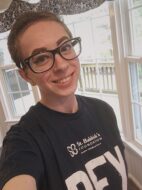
Carling Ramsdell is an M.F.A. student in Eastern Washington University’s Creative Writing program. She is also a co-founder of THE LIT MUG, a literary ‘mugazine.’ You can find her review of John Englehardt’s Bloomland in the SFWP Quarterly and her short story, “The Mermaid Kingdom,” in The Laurel Review.