
CONTRIBUTOR SPOTLIGHT:
INTERVIEW WITH PERRY LEVITCH
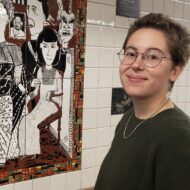 Rappahannock Review Poetry Editors: “In the weeds” displays deep intimacy, power, and vulnerability on a variety of levels. At its core, it seems to be a poem about gender and individual construction of such. Could you speak more to the role that gender plays in your work on the whole? How does intersectionality fit into that lens?
Perry Levitch: Not to immediately puncture the membrane separating the speaker from the writer, but gender plays a significant role in my work because it plays a significant role in my life. As I navigate an evolving relationship to my identity, I find poetry allows me the most access to the tone of “loaded irreverence” I want to muster up in response to the requests, both explicit and implicit, to define my gender in succinct terms. As far as how that relates to thinking about intersectionality, “In the weeds,” as well as a lot of what I’ve been working on about gender, is aspirationally in dialogue with the concept of fugitivity, which I was introduced to through the work of Black scholars, specifically Fred Moten. And my experience of gender, like every person’s, is profoundly informed by my other identities: whiteness, queerness, wealth, and so on. A mindfulness of intersectionality also shades my wariness towards writing about identity at all, as I’m rankled by the possibility that my white, academically situated transness might be misinterpreted (by white cis readers, specifically) as a “universal” portrait of trans identity rather than a slice of an experience that is personally—and even temporally—specific.
RR: “In the weeds” has a disjointed, articulate, and deeply intentional form to each stanza, each line, and each word. What does your process look like when writing a poem?
PL: The first drafts of my poems are usually pretty similar in language and very different in form from their final versions. I tend to draft without line breaks or stanzas and then add those in afterwards; once the world of the poem has somewhat appeared to me in the language, I use form to do as much work as it can to bring the reader closer to that place, too, in terms of visually suggesting things about grouping, pacing, and importance.
RR: We are intrigued by the dramatic dialogue included in this piece. Can you speak more to how you envision the interplay of theatre and poetry? How do the two relate and connect? What does theatre provide to poetry?
PL: Poetry presents, to me, a brilliant opportunity to intervene in the canon more broadly. A whole host of poetry’s most exciting capabilities—reeling the personal and the epic into the same space, manipulating the scale and weight of events, breaking the fourth wall by acknowledging the real and separate subjectivities of the speaker and the reader—allow it to take up (and/)or trouble myth and canonical texts, to make familiar stories suddenly strange or more intimate. The fact that Shakespeare’s world arrives with a lurking queerness, as well as a distinctive, colorful set of words to pun and play with (“garter,” “rosemary,” “weeds”), makes it especially exciting for me to work with, and as a subject matter it presents the opportunity to entangle theatrical performance with poetry and with gender, two other sorts of performance.
RR: We understand that you are currently an M.F.A. student at NYU—how has your experience there shaped your writing?
PL: I workshopped this particular poem last fall actually, so a very earnest thank-you to my classmates and professor for giving their time and attention to this piece. Having to submit new work so often has definitely been an adjustment: as a poet who most often draws from their own experiences, I find myself resenting the mindset I can fall into where I’m milking every personal interaction for potential poems, instead of living my life and letting the writing arrive after the fact. On the other hand, it’s a joy and a mind-boggling luxury to get to spend the majority of my time on something I love.
RR: Are there any new pieces or projects that you are particularly excited about?
PL: I just finished up the syllabus for the class I’m teaching next fall, and I’m eager to spend time with those authors and curious to see how teaching reshapes my relationship to writing. Aside from that, I’m anticipating most of my summer writing “projects” are going to be poems complaining about being far away from my girlfriend (yikes!!).
Perry Levitch’s work in Issue 8.3: