
CONTRIBUTOR SPOTLIGHT:
INTERVIEW WITH KATIE HIGINBOTHAM
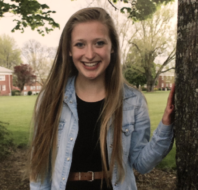
Rappahannock Review Nonfiction Editors: Quarantine is a hot topic for writers because of its instant relatability, yet “Looking for Neowise” repeatedly visits 2014 and your experiences with the movie Interstellar. What about quarantine reminded you or made you think of the movie?
Katie Higinbotham: For as long as I can remember I’ve been terrified by the idea of outer space. It always seemed like an irrational fear, a reaction I couldn’t explain to other people, but it kept resurfacing every time I’d watch anything about space; a documentary, a sci-fi film, you name it. Interstellar was the first movie that caused me to have this reaction in a very public way. Over the course of the pandemic, I’ve found myself re-examining my relationship with this fear and others. I think this is something many people have experienced, but it seems like every small phobia I’ve had over the course of my life has been magnified and brought into focus by the events of the past year. At first, I just wanted to write about seeing the comet, how there was so much hype around this fleeting spectacle. But then I found it impossible to extract the timing of the comet, wanting to see it and not be afraid of it, from everything happening around me. Both watching Interstellar and quarantining were these reckonings with the fact that everything happening “out there” was so volatile and overwhelming.
RR: We love the refrain of “Call it….phobia” throughout the piece. Did the various phobias enter the essay organically as you wrote or was there prior research before you started?
KH: The naming of the fears happened mostly organically. I started by looking up what a fear of space is actually called. Once I discovered “cosmophobia,” I became really curious about all the other little phobias that came up in my daily life and the essay itself. The refrain “call it” became a way for me to represent the feeling of quarantine, the looping track of each day. It also became a way for me to make those fears visible, to call them out and begin to process them on the page.
RR: How do your essays come into being? Do they come from specific experiences, or from connections among different subjects, or something else?
KH: Many of my essays actually start out as poems! Thinking in terms of poetry is an essential way for me to get down those first and strongest images that shape the piece. I’ll see something inspiring when I’m out on a walk, or reflect on a memory that comes up, and write a few lines. I’ll know pretty quickly if the content feels like it’s outgrowing the poem; if there’s too much background needed, or the lines start to get heavier and prosier, then I’ll just start writing paragraphs and it becomes an essay. “Looking for Neowise” began as a poem about my experience watching Interstellar for the first time. I wrote it and didn’t touch it for a few years. Then the natural connections of the comet Neowise and the pandemic presented themselves and I knew it had to become part of something bigger.
RR: What other movies/shows have influenced your work? Are there other films that you plan on watching (or writing about) now that you’ve faced Interstellar?
KH: No plans for any more space movies…yet! But I write a lot about the natural world, so I find myself watching many documentaries on current environmental issues. I love documentaries for the way they mirror creative nonfiction. A good documentary comes together like a lyric essay, telling a larger story through the use of overlapping narrative threads, plus the added textures of voice, music, and graphics. The images and videos of nature doing weird and beautiful and miraculous things, despite humanity’s best efforts to destroy everything, is really uplifting and I can almost always get inspired to write from watching nature’s resilient behavior.
RR: We are honored to be the first to publish your work. What do you hope to write in the future? What kind of story do you want to tell?
KH: Thank you for giving my work a wonderful first home! Recently, I’ve been focused on writing family, different kinds of phobia, and the natural world. I’ve been working on a full collection of essays and poems around these themes, but I hope to follow whatever new curiosities present themselves. This year, I’ve been exploring more hybrid and multimedia forms, and have some exciting projects ready to go out into the world. I want to tell the stories that challenge me to find those new containers, new ways of being on the page.
Katie Higinbotham’s work in Issue 8.3: