
ISSUE 12.1
FALL 2024
welcome
issue contents
> fiction
> nonfiction
> poetry
> art
contributors
interviews
our editors
Isabella Mason
Lines Written in Early Autumn
I take your kitchen scissors and snip off the ends of the flower stems. The variety Trader Joe’s flowers—a sunflower, two carnations, some mums, and a few others I don’t know the names of—were $3.99. I bought them for you, to celebrate our budding relationship. I dunk the flowers into a red, translucent Coca-Cola cup that I’ve filled with water. The cup sits on your kitchen table, empty besides salt, pepper, a few beer coasters and, now, my flowers.
They call these apartments “the Olds.” The Olds are on the campus of a college I don’t attend; their brick exterior is contrasted by the tall, green trees that surround them. They each have a porch where we always go out to smoke. Boys live here, in this apartment on the first floor, so the walls are blank and the brightest thing in the entire common space is the Trader Joe’s flower cup. The table in the kitchen only has two chairs despite this apartment housing four people. I’d like to think that it was made for you and me. There are two chairs and a couch in the living room. I often crawl out of your low, creaky twin-sized bed at three a.m. to sleep on that couch because your bed isn’t made for two people and I haven’t been sleeping well lately anyway.
Your room is a bit better than the common space. You have a few posters that line the walls, but the main attraction of your shoebox room is the bookshelf filled with 250-odd records and the two giant speakers that sit next to it and the turntable on top of it. My favorite memory of this room is laying in your bed—your necklaces hanging on the lamp that leans over your bed like a mobile over a crib—and listening to American Beauty spin on your record player, my face nestled into your chest. In that moment, I couldn’t be happier, despite the storm that follows me outside the Olds.
The first time I was ever here, at this apartment, we were making quesadillas in the kitchen. I wasn’t making much of anything, actually; I just stood there and watched you cut up the avocados as I drank three cans of Pabst Blue Ribbon all too quickly. In my semi-drunken stumbling around the kitchen, I noticed a millipede crawling across the kitchen tile, brown with more legs than I could count. I thought the millipede was charming, and as I kneeled to stare at him on the floor I was surprised to see you lean down and scoop the bug up with a piece of paper. You took the millipede outside and placed him gently in the mulch that lined the borders of the apartment. You tell me later you haven’t seen many millipedes since they cleaned the dry leaves from the porch.
On the eve of my twentieth birthday, a month or two after the leaves were cleared, we are lying in your stiff, low bed, craning our necks to watch the poorly positioned TV on top of your dresser. I steal a sweatshirt from you that night—that stained crewneck that is now a signature part of my wardrobe. It used to smell like you but now it smells like me and cigarettes.
I find my favorite things about you are impossible to write about because they are so cliché—my favorite thing about you is you. I love all your idiosyncrasies, all of your you-isms, and the way you crinkle your face when you laugh so the bridge of your nose meets your forehead. I love your sense of style; the way you cuff your jeans and that gold necklace you wear, with a sun pressed into its pendant. I like that we wear the same size in clothing so we can share. I like that you like cheap beer but will gladly trade your Pilsner for the IPA I ordered too adventurously; that you’re knowledgeable about seemingly everything without being pretentious. I like that there are things you’re meticulous about, like the organization of your record collection, and things that couldn’t bother you less, like where you put your dirty laundry.
Your bookshelf is littered with things that are unmistakably you—a collection of ceramic frogs you’ve found at various thrift stores, various plush animals, and two books which I love but you’ve yet to read (The Catcher in the Rye and Infinite Jest).
That night, when 11:59 turns to 12:00 and I am no longer a teenager, we are on the porch with a PBR each and a pack of Lucky Golds. It used to disgust me, the caramel stench of tobacco that clings so desperately to my clothes and hair and skin, but now it just reminds me of you.
When we first met, I was unsure of who we were to each other. Words like ‘girlfriend’ and ‘love’ had been thrown around, played with the way you’d play with peas at dinner, but being committal felt dangerous.
The next time I come over is a Wednesday night. I borrow a friend’s car and head for the Olds in hopes of feeling something, or perhaps feeling differently. It is dark and cold out; our normal 6pm sunset has fallen back and November nips at my heels. Upon arriving and settling into our usual routine of one beer and old episodes of our favorite shows, you brush my shoulder with your hand. I jump at your touch and shiver because tonight there is something going on with me. Without much thought, I tell you I have to go, though we both know I was planning on staying the night. Neither of us are quite sure what is wrong. I leave, you hug me and tell me it’s going to get better. I don’t know that that’s true.
Thursday morning, I tell you it is over. I am not fit to be in a relationship. I have been so caught up in what is so beautiful about you, that I have forgotten what is so dark and ugly about me, a beast stirring from its short slumber underneath the distraction.
Lately my life has been drowned in melancholy, drenched in illness and soaked in anguish. It is not so much that rich sort of melancholy I feel when I am in love—I’m not sure that’s what this is yet—but rather that sort of dampened droning on that one feels on a rainy day, when it is misting out; not enough to use an umbrella, too much to walk inside with dry clothes. When I was raped four months ago, the rain poured.
* * *
I guess I turned to you as a person who presented some semblance of safety. I had been hopelessly searching, with little fruition, for someone or something to help me feel less broken or more broken or whichever one would ease the pain the most.
Certainly this is naive, but my truest hope when I met you is that you wouldn’t hurt me– I thought that, maybe, if I was really lucky, you’d even come to see me for who I am.
When I met my rapist I hoped for the same things.
I did not get those same things; the bruises on my body did not come close to reflecting the pain he left me with. I was given with a PTSD diagnosis among others, invested unspeakable amounts of money and time into DBT and CBT and ACT and EMDR and CPT and every other form of therapy represented with a glib acronym, fought battles with the Registrar’s Office over how I could possibly adjust my schedule and attendance to accommodate the way I spent most of the lectures I attended in a bathroom stall, attempting to slow my hyperventilation.
All of this left me in emotional debt and he walks freely today without anything even remotely close to the suffering I endure– the flashbacks and the disconnection I face with everyone around me, the crying spells out of nowhere that hurt so badly I heave and wheeze and nearly scream at the power with which the pain is expelling itself from my body.
Where do you come in—you with your sun pendant and cuffed jeans and white Carhartt beanie? When I break up with you I feel naked. I am tired of writhing in this agony but I don’t want to pull you into my misery. I tell you that you shouldn’t have to be my boyfriend because the pain I’m in is much too much for anyone to handle.
Why, then, should I have to handle it? All on my own? I fret for my younger self, the baby girl who will be born into a body that works so much more slowly than her mind, who will become frustrated at every tag in the back of every shirt, the tongue of every shoe, every single sock and the way it sits on her ankle, because she does not yet know how to cope. I am so mad that I must handle all of this. I am not mad for myself, but I am mad for the younger version of me, whom I so badly wish I could’ve protected.
I struggle to understand how you fit into this picture. You are not my therapist, you are more than a friend but less than a boyfriend after we break up, but you are someone I can trust. We recouple soon enough. My desire for comfort and safety prevails over my desire to protect you from myself. Maybe that is selfish. We both buy into this shared delusion that maybe we are special—maybe we defy the odds and live an impossibly happy life. Maybe we are not too broken to be seen or loved.
The flowers on your kitchen table are surely wilted now. In the Olds I care less about what to do next than I do everywhere else. On the porch with my head on your shoulder, passing a cigarette back and forth, I care less about the past six months, how he’s free and I’m not. In that sweet mood when pleasant thoughts bring sad thoughts to the mind, you’re all I can think about.

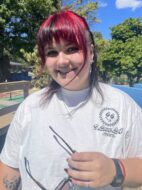
Isabella Mason is an emerging nonfiction writer, currently in an MFA program at the University of Kentucky. As a North Carolina native, she graduated from NC State University with a BA in English and creative writing. Isabella now lives in Lexington, KY with her partner and their cat. Her work has appeared in publications such as Carolina Muse, Stuck In Notes, and MAJORzine. Isabella is enamored by stories and likes to tell the ones she knows best.