
ISSUE 13.2
SPRING 2026
welcome
issue contents
> fiction
> nonfiction
> poetry
> art
contributors
interviews
our editors
Joel Streicker
Common Pursuit
Wayne suggested we take this trip as a kind of second honeymoon. Things had been a little rocky lately, what with him being out of work since the first of the year—another recession—and me having to double-up on shifts at The Red Rooster to make the mortgage and all. We’d also been arguing a lot about having a baby. We both wanted one, but after years of trying we just couldn’t seem to get his sperm and my egg to do their thing.
He still held out hope—“I pray on it every night,” he’d say, as if I’d ever doubted he did—but I wasn’t getting any younger. In fact, every so often I felt like I had a hot flash, and the thought crossed my mind that menopause might strike me down before we managed to call forth a miracle. Because that’s what we’d need. Wayne didn’t trust the doctors but a woman can tell whether she’s got it in her to have a baby and I’m here to say that I don’t. But I didn’t let on, because if it turned out I was barren, he’d be allowed to take another wife, and I had no intention of letting that happen. I tried to persuade him to adopt.
“No way. The kid wouldn’t be my blood,” he said, annoyed that I would even suggest such a thing. “No telling who the parents are. It might even be a mongrel.”
Wayne suggested Pensacola, “the scene of the crime,” he’d said, running his hand meaningfully over my thigh. It’s where we’d first met, him on vacation with some of his buddies from the Vigilance Committee, me with a couple of gals from the Rooster.
“Nah,” I said, “nothing will ever compare to when we met, babe, and I don’t want to spend all vacation making comparisons.” I brushed my hand over his buzz cut, the short hair tickling my palm.
“Trumpworld?” he said. I shook my head. I didn’t trust it after the roller coaster collapsed, killing all those people. “How about Enduring Freedom?” he asked.
I considered for a moment. “No, it’s kind of too much.” The simulated close combat and IEDs there were really realistic. “I don’t go to a theme park to get stressed out.”
We finally decided on Borderlands, which hadn’t been open more than a couple years at that point. It was kind of pricy, but Wayne made a big deal of saying how nothing was too expensive for celebrating a second honeymoon, so I booked a three-night, two-day package.
We spent that first night defeating the air conditioning in a desperate attempt to conceive again. After the second time, we lay panting on the damp sheets, giggling like teenagers. There’s something just so precise about the way Wayne fits me physically that makes me despair because it seems like it would be so easy for it to be taken away from me—by divorce, impotence, boredom, death. And the idea of him with another woman—don’t even get me started. He’s also been a good provider; it’s just been hard with all the recessions lately, and that’s not his fault.
The next day we slept late and then hung out by the pool. A mister blew cold water over the pool area, making the air bearable enough to enjoy being outside, as long as you also had a cold drink, which we did, the resort’s service being excellent in that department. Every so often Wayne would take out his binoculars and train them on the horizon along the border. “See anything interesting?” I teased.
He shook his head. “Not yet.”
We took a long nap, waiting for the afternoon to cool down. Near dusk we headed out with our guide, Charlie, in one of the resort’s armored ATVs. Charlie was as lean and dark and leathery as a strip of beef jerky and just about as talkative. We’d brought our own guns and declined the resort’s tracking services, which may have explained some of Charlie’s closed-mouthedness: No tracking, no tip. The ATV bumped along a rocky path, winding through twisted little trees and scrub that looked like steel wool and razor wire. About half an hour drive from the resort’s perimeter fence Charlie stopped the ATV at the bank of a dry wash. He nodded. “Follow the arroyo,” he said, “it’s your best bet for finding ‘em. Just tap the app when you’re ready for pick-up. And remember,” he wagged a finger at us, “only two per person per season. I can’t tell you how many people get carried away and wind up having to pay a big, fat fine.”
We thanked him and watched the ATV turn around and jolt over the rocks back toward the resort, its headlights playing wildly over the landscape in the growing darkness. It wasn’t exactly quiet when the ATV disappeared from sight—the wind was picking up and rattling the dry bushes, a bunch of birds were whining about something, and there were other sounds made by God knows what. I looked at Wayne. “Let’s go,” he said. We shouldered our rifles and headed the way the guide had pointed us.
I was glad I’d brought a jacket because it’s true that the desert cools down quickly at night. Wayne was still wearing a t-shirt, and I could almost feel the heat still radiating off his arms. Wayne’s like that, naturally hot-blooded. I used to joke that sleeping with him was like sleeping with an electric blanket: Always hot and always on top of me. He’s still hot, but he’s not on top of me as much anymore.
We were silent, and not just because we didn’t want to scare away the prey. After twenty-one years of marriage, sometimes there’s just not a whole lot to say. But there’s silences and there’s silences. I’ve seen old couples at the Rooster who sit in the same booth every day and don’t exchange more than a few words, but you can tell by the way they look at each other that what binds them together is beyond words. Watching them is like sitting next to a river that looks calm but if you jump in you find it’s fast and deep. And then there are the couples that sit at a booth and you’d swear the only thing that keeps them together is that they wouldn’t know what to do with themselves if they didn’t hate the other.
With Wayne and me, it’s enough that we’re in a common pursuit: hunting, fishing, walking Boo, and doing jigsaw puzzles. Wayne was skeptical of the puzzles at first, thought it was girls’ stuff, but after a little while, he took to it. I think it’s because it’s really logical—first you work the edges, which are the easiest part, next you group all the pieces that you think go together, and then you tackle the harder areas. There’s also something really satisfying when two pieces fit together exactly. I love sitting on the porch with Wayne, doing a puzzle, each of us working on different parts of the picture, silently passing the pieces we think go with the other person’s portion until finally, between the two of us, we’ve completed the picture: a jungle scene with a family of tigers, a wagon train heading West, boats in a harbor at sunset.
More and more, I’ve realized how much of what our friends talk about is their kids. They say they mostly talk about the kids even when they’re just by themselves. Linda—she also works at the Rooster—was saying the other day she told her husband once that if it weren’t for the kids, they’d have nothing to say to each other and he just looked at her and didn’t say a word!
As we walked along, I thought about how, if we had a son, we’d take him out hunting, maybe he’d even be with us right now, or maybe he’d be grown already and have a kid of his own. My daddy took me hunting when I was a girl. Back then, it was unusual for little girls to go hunting, but I was an only child, and my daddy loved to hunt, and he loved me, so there you have it. I loved those fall mornings, the air cold, the leaves red and gold and smelling like damp earth, keeping still as possible, focusing on that moment when the deer would come in sight. And then they’d appear, cautiously sniffing. We’d freeze even more than we’d already been frozen. Daddy had a theory. He said that deer were like people; they could tell when someone was looking at them. So we’d only take quick looks at the deer, out of the corner of our eyes. It was hard lining up a shot when you couldn’t look directly at the target for more than a few seconds at a time, but I learned.
Wayne and I are both old-school, so we didn’t bring the semi-autos. Those are for self-defense and shooting for fun. Nope, we brought the Remington 783s, bolt-action, scoped. Simple, no-nonsense: a working man’s (or gal’s) gun. We also decided we didn’t want to use night-vision goggles. It takes the sport out of hunting if you’ve got all these high-tech bells and whistles. If we needed support, we could always call up the armored ATV or even an Apache from the resort, and you can bet those guys have full auto, goggles, the whole nine yards.
Every so often, Wayne stopped and touched my wrist lightly. We’d listen a bit, but didn’t hear anything unusual. He’d turn his flashlight on and check the arroyo floor for tracks. Once he reached out for my hand as we walked, I switched the 783 to my right shoulder and gripped his hand, so hard and calloused.
We must’ve walked for about an hour when we heard a noise that seemed out of place. We stopped. The noise stopped. We waited. Then there it was again—faint, like something walking quickly on the bank of the arroyo, ahead and to the left. Wayne held up his hand, as if to warn me not to talk. The sound grew smaller. Wayne grabbed my wrist—I could tell he was excited—and we walked quickly along the arroyo, stopping every so often to listen.
I motioned to Wayne that we should leave the arroyo—the prey was obviously avoiding the dry wash, whether because it heard us or not, I couldn’t tell. He nodded. We quickly scrambled up the bank and headed toward the sound. It seemed closer now, more solid. I felt that familiar rush of adrenaline, the excitement of the chase, the dance of predator and prey. Wayne got out ahead of me. I could see his broad back plunging through the scrub brush and hear the branches tearing at his clothes and skin. Then his hand flashed, palm toward me, cautioning me to stop. I did. The night was completely still, as if all the life in it was holding its breath, waiting for an all-clear signal.
Then we heard a noise. It sounded about forty yards off. We stood still for what seemed like forever. I looked, and I looked, but I couldn’t see anything—too dark, too much brush. Finally, a tingling feeling crawled up the back of my neck. I could feel something watching me, something silent, hiding. I waved to get Wayne’s attention and pointed toward a clump of brush at ten o’clock. He peered at it for what felt like an hour. Then, without looking at me, he gave me a thumbs up and slowly, quietly shifted the rifle to shooting position. He took a deep breath and held it, and then he fired.
The shot tore a hole in the quiet. A flock of birds took flight, shrieking. We waited until silence returned. Wayne fired again, and this time we heard a frantic scrambling in the brush. He grinned and plunged toward the noise. I ran after him.
We flew through the brush, thorns pulling at our clothes. A branch or something that Wayne had bulldozed through snapped back and slapped me in the face. I was stunned for a moment—it was one of those smacks that brings back bad memories (my dad, old boyfriends, Wayne on occasion). In the time it took to get my head together I lost sight of Wayne, and a second later I heard a shot, followed by a screech.
I sprinted toward the sound, and nearly ran into Wayne. He was lowering his gun and peering into the darkness. Anguished cries filled the night. Wayne turned. His eyes were shining. He grabbed my shoulder and pulled me toward him, planting a kiss on my lips. I opened my mouth. His tongue was frantic with excitement, like a dog greeting its master after a long absence, not knowing where to lick and nuzzle first. I wanted to drop my gun and get down to it right there, rocks and sand and wounded beast be damned.
The screeches got louder. We unlocked our mouths and crouched, rifles ready. Wayne walked a few feet from me—you don’t want to bunch up in a situation like that—and then we cautiously approached the noise. The screeches gave way to moans. I couldn’t wait to see what we’d downed.
Wayne flicked on his flashlight. The thin, white beam looked just like it does on cop shows and crime videos: Twitchy, harsh, making the darkness around it even darker. Wayne swept it back and forth: bushes, rocks, sand, bushes, rocks, sand. Then the light hit something black. We stopped. It was only twenty feet from us. Moans alternated with sobbing. “Cover me,” Wayne said, slinging his rifle over his shoulder and taking out his Buck knife. He headed toward the creature, knife in one hand, flashlight in the other.
I walked in an arc, rifle trained on the prey. As Wayne approached it cried out, in a language we couldn’t understand, but the meaning was clear: Have mercy! Wayne crouched next to it. I crept to the side of it, careful to stay out of the flashlight beam and far enough away so that I could shoot if it rushed me.
It was a girl, a dark-skinned Mexican girl dressed in black. A teenager. She sat with her legs slightly bent in front of her, clutching one of her calves. She had long, black hair, and her eyes darted back and forth in terror between me and Wayne. Even though she was sweaty, tired, bleeding, and scared, I could see how beautiful she was. That’s how they are when they’re young: pretty, strong, clear-eyed. It’s only after they’ve had kids (five, six, eight—Mexican women are baby-dropping machines) that they look like cubes of dark Jello-ed flesh, only good for taking care of other people’s kids or cleaning up other people’s messes.
Seeing us staring at her, me with my rifle and Wayne with his knife, the woman began praying—it must have been a prayer because it was the same thing over and over again, kind of sing-song-y and rhyme-y, and it seemed directed to heaven and not to us. Or maybe it was a spell, because soon Wayne got all slack-jawed, and he dropped his arms, as if they were suddenly too heavy to hold up.
“Agua?” Wayne said, at last. He held out his canteen. The girl kept praying—or repeating the spell—but ran her tongue over her lips, which I could see were cracked and dry. She shook her head. “It’s okay,” he said, “it’s not poison, look”—he unscrewed the top and took a gulp—“see?” He wiped the lip of the canteen on his shirt and held it out again. The girl got quiet. She met his eyes, and then reached for the canteen. She threw her head back and drank greedily, her throat muscles bobbing up and down, rivulets running down either side of her mouth. When she handed it back, Wayne shook it and laughed. “You were thirsty, huh?” He turned to me: “She drained the whole thing.”
Well, I couldn’t see the sense in it. Yeah, I had water in my canteen, and we could always call the guide back out if we ran out, but why take a chance? And why give water to prey when we were only going to put it down in a minute anyway? I didn’t like where I thought this was heading. “Wayne,” I said, “you want to take the kill shot or should I?”
He didn’t even look at me. He just kept staring at the girl. I could see his eyes raking over her body: her thighs and hips, full and solid and tight against the fabric of her pants, her breasts large, jutting at that impossible angle that graces young women’s bodies before gravity, pregnancies, and disappointments bring them more into alignment with the reality of their earth-bound lives.
“What if we kept her?” Wayne whispered. It wasn’t a question, really.
I was shocked. The whole point of the Vigilance Committees was to keep the illegals out of the country.
“What do you mean, ‘keep her’?” I said, anger and panic in my voice. “And what do you mean ‘we’?”
I knew damn well what Wayne was thinking, and he knew I knew. Of course, it’s not technically illegal to own guest workers, as long as you register them and pay the fee.
He kept looking at the girl.
“I certainly don’t want an illegal in the house,” I continued. “And you know that’s why you can’t get a job—too many guest workers.”
Wayne turned to me. “She’d just be in our house, she’d work just for us,” he said softly. I looked at the girl. She was still moaning and chanting under her breath; she must have known we were arguing. Truth be told, the more guest workers the government has, the more work Americans get riding herd over them. Wayne’s last job was a guard at a guest worker center. He’d been fired because of a few incidents he refused to talk to me about.
“And with the new rules, it’ll be cheaper to keep her,” he added, growing bolder. “The president wants more regular people to own guest workers.”
That was true: They were saying it would make the country even stronger.
“Well, I think it’s a bad idea,” I said. “I don’t even think letting the government own guest workers is right: Just having them in the country is contaminating. People start mating with them, and the next thing you know—”
“But—”
I cut him off: “Don’t tell me it isn’t true. Mixing like that poisons our blood.”
“It does,” he admitted, “but it doesn’t happen as much as people say. They just got dirty minds.”
He hung his head. That’s a tell he has, but I’ve never let on I know it. It’s why he’s a shitty poker player and a shitty liar. Fucker, I thought, I can read your dirty little mind even here in the stinking, pitch-black desert.
“How do you think it’d go over with the Vigilance Committee?” I pressed him. That Committee was his buddies. They were who he hung out with, gave him a sense of purpose before he lost his job and now while he wasn’t working; they were the guys who had his back. “What do you think Andy and them’ll say?”
Wayne sat up and shifted the light momentarily from the girl to me. “Watch it there!” I said. “Put that light back on her.” He turned the beam onto the girl. She was now weeping.
He took a deep breath, stood up, and handed me the flashlight. “I got to take a piss,” he said.
“Well, you do some thinking, too, while you’re standing there with your pecker in your hand.” I was angry.
He brushed past me; I heard his footsteps crunching the dirt and rocks behind me.
I looked at the girl, up close this time. She was pretty, all right, but there was a coarseness to her features, like all Mexican women, a mannishness that disgusted me, as if all of them, deep down inside, were really males, as if the male genes were just too powerful to be suppressed completely.
She looked at me. There was something like hope in her eyes. I felt a little bad for her. Who knows what misery she was fleeing down there to be desperate enough to cross the border? Her crying gave way to a rhythmic moaning. Behind me, in the brush, I heard Wayne peeing, a full, solid sound, like a hose when the spigot is open all the way. I imagined his cock in his hand. I’m sure he was thinking about what I’d said, but I didn’t want to take any chances. I stood up and clenched the flashlight between my teeth. I raised my rifle and pointed it at the girl’s chest. Before the shock could register on her face, I’d pulled the trigger, and she was blown backward. Her body jerked around, and a stream of blood darkened the sand, and then she lay still.
“God damn,” Wayne shouted. I heard the last of his pee sprinkle on the sand and then his heavy footsteps.
Wayne rushed to the girl and ran his hands over her thighs and chest fumblingly, as if searching for something he’d lost. He suddenly yanked his hand away; it was covered in blood. He gingerly checked her neck for a pulse.
I kept my eyes on the girl. I lowered the rifle and took the flashlight out of my mouth. “She went for my gun,” I said. “I had no choice. It was her or me.”
Wayne fell back on his butt, clasping his knees to his chest. He started rocking back and forth, head down.
I took out my phone, tapped the resort app, and called up an ATV. “We’re under our limit, but I’m assuming you’re good for the night, babe,” I said to Wayne, hardening my voice, even though I wanted to cry.

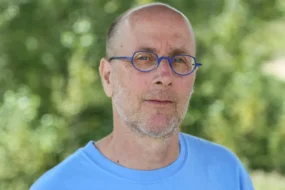
Joel Streicker’s stories have been published in Great Lakes Review, Tupelo Quarterly Review, Burningword, and New Flash Fiction Review, among other journals. He won Cutthroat Magazine’s short story contest in 2021 and Blood Orange Review’s fiction contest in 2020. He has published poetry in English and Spanish, including the collection El amor en los tiempos de Belisario (Bogotá: Común Presencia). His translations of such writers as Samanta Schweblin, Mariana Enríquez, and Pilar Quintana have appeared in A Public Space, McSweeney’s, and other journals. Streicker’s essays have appeared in The Forward, Letralia, and Boletín Cultural y Bibliográfico, among other publications.