
CONTRIBUTOR SPOTLIGHT:
Interview with Samuel McFerron
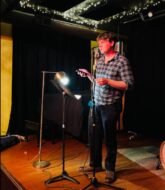
Rappahannock Review Poetry Editors: “Solemnity” is complicated and heavy in addressing addiction, and it also references the Baker Act, a Florida law allowing for involuntary treatment of mental illness. Can you tell us about how you approached these subjects and any challenges you faced in writing about them in this poem?
Samuel McFerron: The biggest challenge of writing this was the form itself, the Ghazal, being heavily personalized. In a lot of my other poems and the stories I write, and I’m sure others who write can relate to this, it’s almost like I’m able to hide behind a mask through whatever voice I use, but the Ghazal form demands an address to the poet in the final stanza, so it would have felt like a lie in a way to write a poem that wasn’t as reflective and based on real experience. I try to utilize each section of this poem as a stage of my own struggles with addiction; The excitement of the lifestyle, the isolation and shame that comes with it, the eventual intervention, anger, rehabilitation, and hope. The turn to Florida and the Baker Act also came from personal experience. I spent a few years living in Ybor City, over a thousand miles away from any relative, and those were quite transformative years regarding these struggles. I, myself, wasn’t Baker Acted, but I have been involuntarily committed, so the connection just felt natural. I think overall, my biggest challenge was just being honest with myself and figuring out a way to write a poem that reflects the realities of addiction without romanticizing it.
RR: We absolutely love the form of the ghazal here, which is such an intricate form to work in, and your choice of “veins” as the radif. How did you land on that word and how did you approach writing in that form?
SM: For me, the only form harder than this one is the sestina, which is a whole other track I’m nowhere near skilled enough to attempt. The ghazal, on the other hand, demands a lot of one’s personality, but it also demands tightness. When I started, I didn’t really know how I would approach the form or what word I would use to end each section, so I actually turned to a word generator app and played around with different drafts of what would eventually become this ghazal. I think the hardest word I landed on was Frog. Veins, eventually, just felt natural. I knew I could craft a lot from that word specifically based on my history, but a big part of me was reluctant to visit it at all. Soon enough, I couldn’t get it out of my head, and then I started imagining the rhythm of the poem, so I sat down and wrote the darn thing.
RR: There is a strong, personal voice narrating this poem, especially with the inclusion of the dialogue at the end. How do you think about crafting the voice in a poem such as this one?
SM: I had to walk a pretty fine line here. “Solemnity” is part of a collection I’ve been working on all told from the perspectives of three-ish voices; one of reason, one of anger, and one of grace, loosely based on myself and two other people. I didn’t write the poem with this project in mind initially, but eventually, it fit right in with the others. As I’ve mentioned, I was reluctant to be so honest with this poem. There are a plethora of experiences that I ended up cutting because they were too, I guess, painful to read and reread as I revised, but all of this culminated in creating a voice that is very nearly just my own.
RR: Does being an editor yourself inform the way your works are written? Do you find yourself appealing to a particular audience?
SM: Oh my gosh, yes, absolutely. It’s such a privilege to be able to see the landscape of contemporary poetry on a daily basis, and even more so to be able to build a network of friends and mentors through my position. I’ve met so many wonderful poets, many of whom I’ve had the honor of helping to publish, and these experiences certainly changed the way I write and they continue to daily. So my audience is kind of just everyone I’ve met and want to make proud, be it the English and Philosophy Departments at Lewis, Dr. Simone Muench who has taught me so much in our years of friendship, my family, friends, fellow editors, other poets, and the list goes on. My writing is for everyone I want to do right by. If I had a singular audience, however, it would be my mom. I know that’s corny, but every time I write she’s at the forefront of my mind.
RR: Working for Jet Fuel Review is quite the opportunity; do you have any favorite works you helped to publish that have influenced you as a poet?
SM: That’s a very long list. The writers who immediately come to mind are Cynthia Manick, Faisal Mohyuddin, Esther Sadoff, Mina Khan, Jeremy T. Wilson, Dustin Brookshire, Camille Newsom, Mike Puican, James Fujinami Moore, Jules Wood, Rita Mookerjee, and there are so so many others whose works I cherish. It’s incredibly difficult to pick a favorite author or piece but one that has really stuck with me over the years is Joshua Bird’s “Enter Throughout Tautology,” from JFR’s 24th issue. Outside of all things literary, though inseparable from them, I study philosophy, with a particular interest in phenomenology, and Bird’s poem served as a sort of signal to me on how to connect these two pursuits. Outside of personal resonance, it’s incredibly well crafted, and one of those poems that demands to be reflected on and revisited, even years after an initial reading.