
ISSUE 12.2
SPRING 2025
welcome
issue contents
> fiction
> nonfiction
> poetry
> art
contributors
interviews
our editors
Marika Guthrie
If You Could Convince Me to Talk About Bellingham
Content Warning: Please note that this essay contains themes of domestic abuse and violence that may be upsetting to some readers.
If you could convince me to talk about Bellingham, I guess I would start with that package of Double Stuff Oreos on clearance. That would put us right into the thick of it. Past the honeymoon phase of dragging an expiring relationship into a new town into a new state. Past the optimism born of being young and truly out on our own for the first time.
Let us start with the $0.97 package of Double Stuff Oreos, because I can’t possibly begin with you being hit by the Bellingham city bus. Riding home from the liquor store on our bike, our bike because we could only afford the one. Coasting along. Your black combat boots on the pedals. The loose dog that startles you off the sidewalk into the street. The panic on the driver’s face when you are levitated by the impact, bright in the headlights, suspended over our bike—a soul leaving its body, the bottle of whiskey gripped in your left hand. The hollow, dark sound your head makes on the pavement. The Jack Daniels, unbroken, rolls against the curb. I can’t start with this because despite my daily efforts to conjure your death, it never happened.
So, those Oreos. I never knew I could be so hungry. Were you ever hungry in Bellingham? You must not have been. Not hungry enough to get a fucking job. I had a job, but god was I hungry. Tuesday through Friday, from 10 a.m. to 4 p.m., I wore my white button-up shirt, black slacks, sensible shoes, and a tidy high ponytail. Seafood puttanesca, spaghetti pomodoro, cacio e pepe on wide white plates with bread and piped butter. Cappuccinos in unreasonably small cups with frothed cream, sambuca chilled in a martini glass with the sanctimonious trinity of espresso beans. Everyone around me, eating, eating, eating.
Working the floor alone, collecting my dollars from sullied tables, folding them into a fist in my pocket. A fist that wouldn’t make a dent in the rent, let alone the utilities. Nick (the cook) and I bullshit and share a joint sitting on empty kegs in the alley before closing the restaurant between the lunch and dinner shift. Someone has spray painted a dick next to the fire escape on the building across from our back door, as if the world doesn’t have enough dicks. When the dishwasher takes his break, Nick sneaks me my one meal of the day, sauté di vongole. I eat the briny clams in white wine sauce with whatever bread I can steal, while piping clouds of whipped butter into ramekins. When Nick isn’t looking I stuff one more warm bread roll into my serving apron before clocking out. I don’t know why I bother, he never says anything about the bread. I lick the butter from my fingers.
Maybe you wouldn’t be there when I got home, I think as I unlock, then straddle, our bike. In my chest the brief temporal thrill of unhurriedly gliding through the gray drizzle of a Pacific Northwest spring, navigating wave after wave of the creamy magnolia petals that fill the downtown streets. There is no money for gas, but that’s alright. If we had gas money you would drive to the restaurant to pick me up like you had in Arizona, revving the engine and blasting the horn if I was a minute late. All my coworkers tactfully ignored how I slinked out embarrassed, their pity so strong I was surprised you couldn’t smell it on me when I got into the car. I ease onto Walnut Street. Closer to home now. I pull over to admire an iris emerging, plum and gold from its sheath of green. Maybe you won’t be there, or better yet, you would have had an aneurysm while I was at work.
Slumped over your guitar in the plaid recliner that isn’t reclined. The finger loose on your hands, useless, harmless now. A guitar pick, one of the hundreds I stuffed into your birthday cards over four years, laying just above your knee as if you had set it down. A red not-quite-arrowhead-not-quite-heart on your jeans pointing toward me as I walk in. Your profile is quiet with your ear laid on the broad, polished rosewood curve of the custom-made guitar. I stand for a full minute looking at you before I turn and go for the phone. With this in my mind I smile the rest of the way to the little blue house on Maplewood Avenue. But you are always there. You open the door before I can grasp the handle. “What took you so long?” I don’t answer. Instead I hand you the cooled roll from my apron and wait to see if you might choke.
Right the Oreos… the Oreos come after the night the three of us, you-me-our roommate Cody, poisoned ourselves with mushrooms a coworker at Home Depot gave him. Cody had a job, smiled a lot, paid half the rent even though there were three of us. Your best friend who followed you as you followed me as I followed my education fifteen hundred miles away from Phoenix. We make bitter tea with the red-capped bits, but no one trips except over each other to get to the house’s only bathroom. The next day I wearily clean vomit out of the kitchen sink. When we recover several days later, we decide to grow our own psychedelics and not risk trusting ever again.
Sitting in the corner of the couch in the living room, I page through a university supply catalog ordered off a website using the dial-up internet at the city library. Spores of all varieties can be bought for academic study. You lean against the wood-paneled wall and pack a glass pipe with Cody’s weed—lately it’s almost always Cody’s weed. I pause to look at you, not looking at me, your long hair tied back, the loose, white-blonde curls around your temples like the fine threads spiralling off a yucca in the desert sun. Suddenly, I am so homesick I have to pull my knees up to my chest.
The window above your head is slick as a mirror with late afternoon rain. I see my reflection above your bent head like a Marian apparition and suddenly, there you are, face up at the bottom of Squalicum Creek. Your eyes closed, those white curls unfurled in the slow current. Maybe you slipped walking along its edge. Maybe the water saturated your jeans, weighing you down. Maybe the heel of your boot caught in an underwater tangle of roots. Maybe you hit your head in the fall. Cody and I would be out hunting for you when we stumble onto your body, submerged, somber, gray. I peer down and know it’s you by your hard-hooked Roman nose. All around you the salmon swim on to further shallow waters, their bodies blooming red, red, red before they can fuck, rest, and rot. Cody jumps into the water to pull you out. I wonder if I would even cry.
Unnerved, I turn back to the mycological summaries and start reading aloud. You light the pipe, inhale, cover the bowl with your palm to preserve the ember and hand it to Cody. I flip the page and read aloud “Psilocybe cubensis. Penis Envy.” Both of you cough out the smoke in a laughing fit. Cody hands me the pipe and gives my shoulder a little bump with his fist. Friendly, intimate, kind. I see you see this. I see your jaw. You worry that we are fucking behind your back. We aren’t. We never have. We never do. Later that night you force me awake for silent, dark, menacing sex on our mattress on the floor. While you thrust your way upstream I picture the salmon and wish after this fuck we would both lie down and rot.
I drop an envelope in the mail the next day, the order form filled out with my hand, along with the check from Cody’s bank account. Three weeks later we get a little bag of penis envy spores in three clear syringes. I decide to hike through Cornwall Park while the two of you sterilize the kitchen in preparation to make cakes of perlite and rice. Tiny grainy temples of illegal agriculture. Six months in this house and you haven’t wiped down the toilet seat or washed a dish, but now only your keen attention to detail can be trusted to avoid contamination. You drone on at me about the consequences of an unclean environment for the spores. I watch your relentless mouth and think of the cadaverous remnant of a wild hare I found on a foot trail to the creek a couple of weeks before. A miniature landscape of bone, gossamer hyde, and gaunt sinking tissue; from a fissure in the animal’s gut thrived an unruly thicket of wild mushrooms. The kitchen is too small for three, so I leave you to boss Cody around with a bottle of bleach while a cassette of a live Grateful Dead show, recorded decades before your teenage parents got knocked-up, blasts through the house.
I leave our bike and walk the few blocks down Maplewood Ave to Cornwall Park. On our street I pass the neighbor who has a couple of easy chairs under the roof of their splintered deck. Moss grows up the slumping fabric skin of the recliners. Dog shit– dog shit and dandelions everywhere. I have never actually seen a dog in that yard. The chain link fence upholds the brittle, reaching, grasping skeletons of wisteria vines.
A half a block further I stop in front of another neighbor. A miniature gypsy’s cart of cut flowers in mason jars by their mailbox. A hand-painted sign:
Large Bouquets $10
Small Bouquets $5
Please leave Jars
Money in the Honor Box
The honor box has a laughable little gold lock. I flick it with my fingertip. The spring bouquets are generous. The summer bouquets will be beyond shameless. My landlord had shown me the cover of the edition of Sunset Magazine this very house was featured in. I take out a large bouquet just to hold it. Just to feel the weight of it. The house is barely visible for all the green budding lilacs, honeysuckle, ferns, heavy evergreens, and dogwoods not yet blossomed. They must have a greenhouse in the back full of Gerbera daisies, primrose, lavender. I set the flowers back into the mason jar. No money for food. No money for gas. No money for flowers. Barely enough money for weed. Always a little bit for whiskey. Nothing for the honor jar.
I haven’t forgotten the Oreos, but first just let me remember Cornwall Park. My Phoenixan heart could not make sense of the city parks in Bellingham. When I entered Cornwall Park for the first time, it was as if the thirsty, exposed, falsity of Arizona parks with their patchy soccer fields, parking lots, and playgrounds too hot to touch were an impossibility, a science fiction that had never existed at all. The trees of Cornwall blackened out the sky, ferns grew seven feet tall, vines sprawled on top of vines on top of vines and wove like inextricable lace into the wild rhododendron branches while moss and lichen assuaged the granite that rose up from the ground. Everything, everything, everything was wet.
In the beginning, we went together to the parks. Held hands and wandered, stoned, through the fern forest until we were certain we were lost. We would slip off the trail, through the density of somber lacey wet fronds, to make out on the damp ground. Your hand up my shirt, under my bra searching for some soft, yielding part of me. Around my head a florid living crown of speckled, fleshy, pink pitcher plants; their yawning, sagging throats stagnant with digestive juices and the twisted bodies of flies and small wayward beetles. I was still trying to meet your mouth with something other than indifference back then, but it was already too late. I had not wanted you to come to Bellingham, but there you were… with your tongue coiling inside in my mouth. It took everything I had to not bite it clean off.
You and Cody set to making the perlite and rice cakes that will be injected with penis envy, which will go into a seventy-two-quart Coleman cooler with a fish tank bubbler and will begin almost immediately to produce unimaginable masses of mushrooms, that will then be dried in shoeboxes and crushed into powder, powder we will scoop into gel capsules from Natural Grocers, those capsules will fill old spaghetti sauce jars to overflowing on the shelf next to the whiskey, with the whiskey the capsules will go into our mouths, and once in our mouths, penis envy will become just another dependency. While you and Cody work in the kitchen of the little blue house, I flee into Cornwall Park alone.
It is empty on Monday morning with the exception of an ancient Subaru that someone is living in. I take a path that goes by a feral cat colony, but am disappointed when I see none. The brooding ferns drop water on my head as I walk, but I don’t pull up my hood to protect myself. I want to lay down in some surreptitious place. I want to languidly smoke the pinner Cody slipped into my hand as I left the house. Ahead is a tall granite outcropping with a flat space on the top. Leaving the trail, I climb carefully up the back of the rock, watching for the tight patches of violets sheltering in the footholds. On my back now, I slip the pinner between my lips, light it, breath in. Overhead, through a break in the trees, there is blue sky. The clouds have lifted for the first time in months. The sunlight doesn’t reach me, but I know it’s there. I take another hit. Somewhere nearby two ravens banter back and forth and for once I don’t imagine your death; instead I consider my own.
Although I can’t hear it, I-25 is only a couple blocks away. A semi-truck. It could be so, so quick. I blow smoke out through my nostrils, my eyes closed, picturing a Shamrock Foods truck, maybe the one that delivers to the Italian place where I work. What is the driver’s name? Ronny. That’s right. I hit the pinner again. Fill my lungs till it’s painful and hold it. He’s a nice enough guy, Ronny. He shoots the shit while I sign invoices, has an easy laugh and a head of thick dark hair. I shouldn’t do that to Ronny. Step out in front of his truck. Fuck up his life. Anyway, my parents would never survive it with my brother dead not quite three years. I open my eyes and exhale the smoke up toward the blue sky and the sunshine I cannot feel.
I’ll be honest, from here it gets hazy on where the Oreos fall in all of this. Were they after the night my sister calls the house around 9:30 p.m., or were they before? It doesn’t really matter. You hand me the phone, then go and sit away, but not quite far enough away. Before the call you had been on your way to the patio for a cigarette, now you seem to have forgotten the pack of Marlboro Reds in your pocket. I put the handle to my ear, unable to escape the dining room because of the shortness of the phone cord. We are both trying for nonchalance. You eavesdrop while tuning your guitar. Me turning away, so you can’t see my lips. Jessie is at a party and drunk. She holds up the phone in a crowded room in Colorado and says, “Everyone say hi to my little sister!” On my end I hear muffled greetings and laughter. My large striped cat weaves around my legs as Jessie shouts in my ear. She wants to know how I am. She wants to know if you’re still a useless piece of shit. She asks the room full of happy ski bums if they think I’m hot. The response is loud enough to stop your guitar.
I force a laugh and tell her to tell them to fuck off, which she does. I have never wanted to be her more in my life. We often pass for twins despite our six-year age difference, but she’s in love in Colorado and I am here with you. She suddenly hands the phone to the man who will one day be my husband. We met at her wedding last summer, the wedding you weren’t invited to attend. He and I exchange awkward pleasantries, what else is there to do? I can tell that you can tell I’m no longer talking to my sister as you get up to go get whiskey from the cupboard. You pour yourself a glass instead of drinking from the bottle, lengthening the time in the kitchen nearer to my voice. Jessie takes back the phone, says she loves me, says I’m too good for you, says I must move to Colorado and by the end of the summer her intoxicated rambling will be proven to be prophetic. Only after I end the call do you head out to smoke.
I follow you outside to be companionable, to ease the tension, but you ignore me, sitting perched on the handrailing of the porch. I walk down the steps into the grass. The large striped cat follows me and so do your eyes. My feet are bare. The ubiquitous fog has lifted, but the heavy, saturated sky catches all the lights of Bellingham. Night the color of summer sorbet. In the back of the yard the distant pear and walnut trees are black in contrast to the sky. You say nothing to me, I’m used to being cold-shouldered, so the cat and I wander back on our soft padded feet to where the old walnut shells litter the ground and from that shelter, I watch you. The flare of the hot cherry at the end of the cigarette as the smoke is pulled into your lungs. The vapor brushes sizzling fingers along your pink spongy tissue, blistering the skin into tar, but slowly. Decades from now you open your mouth to tell me off, call me a whore, and nothing will come out but your last burnt breath. You are killing yourself, but too slowly to do me any good.
I’m getting to the Oreos, but not quite yet. I need to remember laying on the ground next to my vegetable garden. Our landlord, Steve, had scandalized my desert suburban upbringing when he walked out into the smack-dab-middle of our perfect grass yard and with an edging tool cut out the sod in a twelve-by-ten-foot rectangle. When I told him I wanted a garden and pointed to the discreet, overgrown plot behind the garage he said, “Well, that’s no place for a garden.” I took the sections of grass from him as he cut them out. The ground underneath was so black it was as if Steve was rolling back carpet to reveal a hole you could fall into.
Steve lived right next door. Sometimes he invited us over to drink beer in glass bottles and walk through his grape arbor, stand by his koi pond, laugh at his unruly flock of pet ducks, pick blueberries in distracted handfuls to pop in our mouths while he told us about his thirty years as the owner of the local radio station. His wife joined us when she wasn’t defending children in the court system. Steve had given me seeds and advice, but he could have probably kept the advice; the earth of Bellingham took each dry hard seed into her darkness and transformed it with no assistance from me. Even the ground under the squirrel feeders Steve placed all over yards for his own delight sprouted fruitful, cramped gardens of corn, sunflowers, and rye. My garden needed very little from me, but I weeded her rows in reverence anyway.
I finish weeding and am laying on my side watching the way the afternoon sun fills the new lettuce heads with light, when you come out of the house with your guitar in hand. It is early summer now. I hear the back door and your foot falls on the wood steps. A blue jay lands on the pine fence and hops from slat to slat, scolding my large striped cat as he creeps through the bleeding heart plants, hunting mice. The cat turns one ear toward the bird, but continues with his errands. You sit down cross-legged near the top of my head. I reach out a hand and trace the feathery green tops of carrots that underground, are thin as sewing pins. I fantasize about eating them straight from the garden, not waiting to wash them, the bits of soil gritty and coarse as salt in my mouth. Fierce young corn stalks grow in rows that are neither tidy or straight.
“I wrote you something,” you tell me, and I turn over so I am on my back looking up into your face. Intent, you test the strings, adjust one till it sings right, then play. There are no words, just twelve beats long in 4/4 time, and it is bitingly perfect. You run through it twice and look at me in earnest. I smile honestly for the first time in months. You smile back, pleased with yourself. “Play it again.” I tell you, and you do. The notes are somehow both bright and melancholy and suddenly I feel very naked. You run through it a third time and then let your fingers slip into something more familiar. I watch you recede into the music. What if a bit of scrap from a seaplane plummeted from the sky right now and struck you down before my eyes with the song you wrote for me still in my ears.
A private seaplane coming back to one of the Bellingham marinas after a day trip to Roach Harbor. The pilot taking a low circle over the city to look at the tops of the blooming trees when something small he wouldn’t miss finally succumbs to a rusted bolt and drops away over 1613 E Maplewood Ave. Drops like a bird shot out of the sky, straight down, down, down. Silent until it hits you with enough force to end our mutual misery. I jump up startled. The blue jay takes to the sky when I run for the phone. As I wait for an ambulance, I put my head in my hands to try to hold all the tempestuous things spinning inside. The song, twelve beats in 4/4 time. The careful, colorful, exquisite drawings you used to slip me in class, too shy to speak. Laying on the hood of your dad’s truck in the saguaro flats beyond the Salt River watching a winter meteor shower. The first time you shoved me hard enough to knock me down behind the closed door of your bedroom. How the span between the tip of your thumb and index finger almost fit around the entirety of my neck when you started to strangle me in a hotel shower. That same hand gently, gently guiding lengths of impossibly thin wood into shape at the lutherie school where you built guitars, top of your class. And over and over the sound of my name in your mouth, in awe, in lust, in hatred. An actual ambulance races down Northwest Ave, past the strip mall beyond our back fence and I remember where I am. You play my song again as the cat slinks under the porch, wary of you since you threw him across the dining room. I look to the sky, no seaplanes.
I bought the Double Stuff Oreos for $0.97 because I was hungry. I had started summer semester at Western Washington University a few weeks before, the year spent gaining residency behind me. I worked and went to school and cleaned the house and tended the garden. You drank. Each week I peeled layers off my fist of dollars so you could eat, but I don’t think you ever ate. The fist dwindled and dwindled until it was nothing more than a middle finger. I got home from school and you weren’t home. Cody’s car was gone. No note from either of you. In my nightstand there was the diminished roll of money, flipping me off. I put it in my pocket and grabbed a backpack. The grocer was only three blocks away. I paused halfway over the Northwest Ave bridge to stare down at Squalicum Creek and the blackberry brambles that housed the summer homeless. Tents and tarps erected in the thorns and thickets. I see nothing moving down below besides the water of the creek.
In the store I grab a handbasket, because a cart is too depressing to even consider. I select cheap bread, cheaper cheese, a small jar of Jiffy peanut butter, and a half dozen eggs. In the breakfast aisle I count my money discreetly and do the math in my head. I am reaching for a box of cream of wheat when I see the end cap filled with cookies. A big yellow sale sign reads, Select Nabisco Products $0.97 plus tax. I flipped a package of Double Stuff Oreos over to read the label. Calories: 140 per serving (two cookies) approximately twenty servings per container. I put the package in my handbasket. I can eat two Oreos a day for the next several weeks.
When I get back home the house is empty. I put away the groceries and hide the cookies under the sink near the cleaning supplies. I need to water the garden, but I don’t even make it out the patio door before I am reaching back under the sink, knocking the bottle of detergent over. I tell myself to take a breath. Relax. Relax, they’re just Oreos. The pull tab peels back easy as you could like and there they are… rows and rows of tidy, thick sugar sandwiches. Just one. I’ll just eat one. I extract one oreo and twist it apart, exposing the silky white belly of cream. I set my teeth into it halfway and drag the filling off into my mouth. I’m not sure when I started crying or when I slid down onto the kitchen floor; but here I am. My back against a cabinet with my knees up, weeping as if my brother had just killed himself all over again. The plastic package trapped between my thighs and my stomach, crackling in protest as I rock in tight short jerks. Inside the grooved trays are empty, completely empty.
We finally got to the Oreos, but the story isn’t over. If we talk about Oreos we have to talk about whiskey. I know that you didn’t know about the Oreos. You and Cody return home long after I had discarded the package in the neighbor’s trash can, washed my face, brushed my teeth, smoked a joint. You guys had been hiking along the train tracks down the sound looking for Teddy Bear Cove, the nude beach. We eat buttered noodles with the first leaves pulled off the romaine lettuce at the picnic table outside. Cody hands out beers. We sip and talk about your adventure and swat at mosquitoes till their numbers drive us into the house. I do my homework for Technical Writing and go to bed early. I have work tomorrow. You and Cody stay up late playing video games. The whiskey bottle sits untouched in the kitchen.
I wake up at 2 a.m. confused at my sudden alertness. The house is quiet except for the Enya cd we play on repeat to battle insomnia. I turn over, but you aren’t on your side of the bed. I prop myself up on my elbow and blink into the dark. You are sitting fully clothed on an overturned milkcrate next to the closed door. You even have your boots on. Then I hear it. Thump. Thump, Thump, Thump. A dry, controlled beat in 4/4 time out of sync with the cd. In your hands, across your lap, is the pistol-handle shotgun your dad gave you. The one we passed around at parties and used to blow watermelons and beer cans to smithereens. The barrel of the gun is creating the percussion as it gently strikes the cup of your palm. It is impossible to see your eyes, but your face is turned toward me. I shift and your chin tracks my movement. I am naked except for a pair of panties. The door is closed. Thump. Thump. The light cotton sheet is suddenly effective as a straight jacket. You must see that I see you. My legs can not kick quickly enough to be free of the cumbersome fabric. I still my legs. I try to still my breathing. You say nothing to me. Make no demands. Thump. Thump. Thump. Thump. I could scream for Cody. He is sleeping less than ten feet away. You still say nothing. You track my slight movements with your eyeless face. You might shoot him. If I scream, you might blow your best friend away. Something animal from within commands me to be quiet, to wait. You bring your right boot up and set it on your knee, making a platform out of your calf. The barrel of the shotgun pivots toward me. The thumping has ceased. This is it, I think, he’s going to kill me. I don’t dare close my eyes.
But in my mind I leap up. The sheet is slick as quicksilver and I am out of it like deer springing from a shadow. You are struck dumb by my speed, by my white body flashing past you out the bedroom door. Out the front door. Down the gravel driveway. Across the street. I make for the bridge and throw myself down the embankment. Into the blackberry bushes that grow twenty feet tall and cover the paths all the way down to the beach. I pump my arms. The thorns catch and tear but I do not slow. My bare feet slap the worn dirt path. I run and run and run through the maze of barbs till I can see the water, and even then, when I can taste the brine salt, smell the oily edginess of marine rot, and see the lights of fishermen’s boats rocking rocking rocking, I do not stop.
This doesn’t happen, but nothing else does either. After about twenty minutes of looking at my own death, I realize that you have slumped on the crate. The open eye of the barrel is still turned toward me, but has drifted up above my head. The thump in 4/4 time has been replaced with a deep, swooping, breathing. You have passed out. I slide up on the bed and your eyeless face does not move. I brace myself and move into a squat, ready for you to wake up suddenly, but you don’t. I creep over to you. I take a breath, then I lift the gun out of your lap. You offer no resistance. I am acquainted with the feel of the shotgun in my hands, the weight of it familiar… friendly. If I wasn’t shaking so bad I would straighten up to my full height, just shy of six feet, take a long step back and lift the weapon up so it was even with your chest. It’s supposed to make you look badass, the pistol handle. I don’t feel like a badass in my panties, topless, in the dark, holding this gun, with Enya singing in the background. I unload it, holy shit it really was loaded, and slide it under my side of the mattress. I pull on a t-shirt and shorts and watch you sleep on the milk crate till the sun comes up.
I find the empty whisky bottle on its side in the living room before you wake up. I leave it where it is. Maybe you will slip on it. I can picture it. Your foot going out from under you. The way your back arches as you try to catch yourself. Your arms wildly reaching out around you, but too late. The crunch of vertebrae as… I stop myself. No more. I will manifest your death no more.
If you could convince me to talk about Bellingham, I would start with the package of Double Stuff Oreos on clearance. That would put us right into the thick of it. And if, if you could convince me to talk about Bellingham I would end with how I finally conjured my great escape, because despite your daily efforts, it happened.

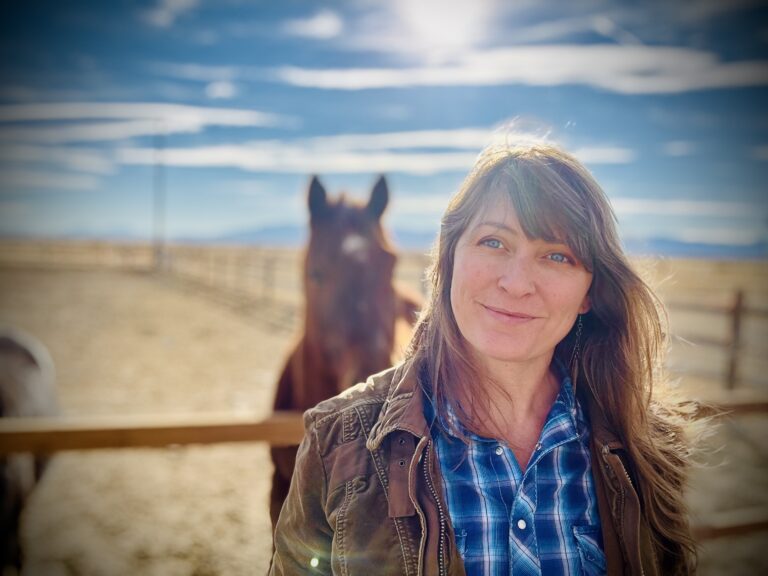
Marika Guthrie is an emerging writer residing in Pueblo, Colorado. She is an nontraditional undergraduate student currently attending CSU Pueblo, pursuing a major in English with an emphasis in creative writing. Marika is an ardent horsewoman, a sometimes artist, a stumbling philosopher, and a poet. She has been published in The Baltimore Review.