
CONTRIBUTOR SPOTLIGHT:
Interview with Claire Scott
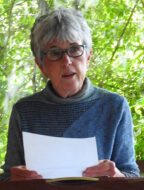
Rappahannock Review Poetry Editors: In “Covering Our Bases,” the idea of doing that performance of “doing doing OK” found in lines 26-27 really stood out to us, and smoothly leads the poem to its end. Where did you find the sentiment of “doing doing OK,” and what was it like for you in trying to convey it?
Claire Scott: The first “doing” is a play on the word “doing,” since the writer is clearly doing less and less as she ages. The second “doing” is more about loneliness and resignation. She is not doing OK, but is reluctant to acknowledge it. The poem dwindles to four syllables in the last line to reflect this.
RR: We were really intrigued by the shape the poem takes. How has your usage of form changed over the course of your writing career?
CS: At the start, I pretty much stuck to stanzas left justified. Then I went to putting words and lines all over the page, experimenting (probably not too successfully) with white space. Now I am somewhere in between. The first stanza of the poem is more about expansion and possibility, while the second is about contraction. I wanted the actual lines to mirror this shift.
RR: We love how the language, punctuation, and pacing bring out the speaker’s voice in this piece. What was it like bringing this speaker and their anxieties to life?
CS: Like most of my poems, there is a bit of me and my life in this one. Poems for me are like seeds, some watered by life and some by imagination. I just turned eighty-one. I have found that with Covid and a recently diagnosed incurable (but not fatal) disease, I have become more cautious. But I really miss rambling alone for hours in the woods. And I lock my doors during the day.
RR: Do you have any advice you’d like to share for poets looking to publish their own work?
CS: Just keep at it. It helps if you have a few poets to give you feedback. Don’t get discouraged.
Rejections do not mean you are a bad poet. One poet made a collage of all her rejections. I find submitting poems the least exciting part of writing. I try to submit one or two before I start writing. Broccoli before dessert. I also take days off from submitting. There are websites that list journals that publish poetry. Also, when reading a book of poetry, look in the back to see where various poems have been published.
RR: The anxiety present in this poem had us discussing the role of mental health. In what ways do you think poetry can help us explore mental health challenges?
CS: In my former life, I was a therapist. I have found many parallels between writing poetry and being a therapist. Both are a combination of creativity, play, improvisation and the plain hard work of analyzing, editing, reading and re-reading. I find when I am going through something tough, it is extremely helpful to write. It becomes a blend of familiar and surprise, writing in altered light where anything can happen. Writing keeps my heart open. I don’t think you can write anything meaningful with a closed heart.