
CONTRIBUTOR SPOTLIGHT:
Interview with Michael Galko
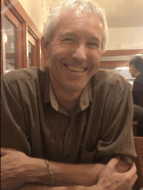 Rappahannock Review Poetry Editors: The speaker has such a strong presence in “People Who Play Chess”; it almost feels like the audience is engaged in conversation with them, or in their mind as they watch this chess game take place. How did you develop the speaker in this poem, especially their discomfort?
Michael Galko: Ultimately, as you note, the poem is about discomfort–in particular the experience of it in the mind. Those little niggling things one sees each day that knock insistently inside one’s brain. It was natural for me to build off of chess for that–an easy starting point was the odd wariness that I’ve felt watching people play chess in public spaces. To be clear, I don’t actually begrudge people who enjoy chess. Like many poets I have a side gig as an unpaid flaneur–just walking around observing things and people. This of course leads to a bit of stream of consciousness self-talk and the poem tries to capture or sample that random internal conversation–to borrow your well-chosen word.
RR: Of course chess is a key focus in this piece, but as you read further it becomes clear that this isn’t entirely about chess, if at all. Where did you get the idea to make chess the focal point in this poem, and how did you go about tying it to these much larger ideas and fears?
MG: I started with chess because of my own uneasiness with this game–the strict rules and the depth of the strategy which involves a bit of trickery and disguise of intention. But, as happens when one is flaneuring (is this a verb?), this jumping off point led to other associations, a small cascade of other discomforting ones within the poem. There is a lot to feel uncomfortable about if one is just a person existing in our world–just as there is a lot to marvel at. However, the focus in this poem is the discomfort, which is only a small step away from larger feelings–like fear. I’d love to have no war. No predatory capitalism. No con-men and deceit–other things that pop up in the poem once the associations start flowing. Alas, we can’t individually control any of those big topics and the fear that accompanies them, except perhaps through living decent lives and building local communities with decent people–even those who might enjoy chess in the park!
RR: How do you find balance in your work as a scientist and your work as a poet? Has this ever given you challenges or inspiration?
MG: It has not been easy to strike a balance. Running a research laboratory (mine studies wound healing and pain) is demanding. Over the years I’ve had to develop ways to guard enough protected time to write creatively. Although the sciences and arts are often thought of as separate (or at least different) to me, doing both, they have a lot of overlap. Mainly, they are both ways of understanding the world–just using different methods. They both require a high degree of creativity and persistence. That said, only a very few of my poems deal with science at all–probably well under five percent. The inspiration part I suspect is just trying to understand certain aspects of our shared world. Science is good for questions like–how does pain happen? Poetry is good for questions like–why and how does my mind run away from me when I see people playing chess?
RR: Do you have any upcoming projects or publications that you’d like to share?
MG: I’ve been putting together a few full-length poetry manuscripts and also dabbling with novel writing but nothing published as yet. I will be retiring from science in a few years which will allow me a couple of decades (hopefully) to really focus on creative writing. I’m very much looking forward to the shift to writing full time. I’m ready for it.
RR: How do you feel about checkers?
MG: Ha! Such a simple game–but not! Full disclosure my favorite game is cribbage, a card game that is an interesting mix of luck and skill and uses a cute little board for counting.