
CONTRIBUTOR SPOTLIGHT:
Interview with Rachel Aviva Burns
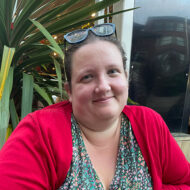
Rappahannock Review Poetry Editors: In “Sitting Shiva,” something that was particularly striking to us was the image of the hard-boiled egg stained purple in the final stanza. How did you land on that image?
Rachel Aviva Burns: “Sitting Shiva” is a poem based on the shiva for my grandfather, who died when I was eight years old. It was my first experience of a loved one dying, and my first experience of Jewish mourning traditions. The image of the stained hard-boiled egg is one of my real memories of that time—I remember thinking it was odd that the egg turned purple even though my hands were blue. Thinking back on that memory as an adult, I was struck by how my childhood self was focused on this detail amidst a much more emotional event, and also how the stained egg can serve as a metaphor for the bruised innocence of a child’s first encounter with mortality.
RR: There’s a real sense of maturity and awareness in this poem even though the speaker is a child; what is your key to balancing that style of voice and the youthful nature of your speaker?
RAB: I don’t know if I have a key! This is very much a poem about looking back on the self as a child, so while at times, the voice is that of my childhood self (“I count the small round rocks”) I also bring in ideas that I would not have had as a child (specifically, in the stanza that includes a reference to Brownian motion).
RR: This poem contains a lot of contrasting subjects and themes, like the scene of the family in mourning and the much more contained scene of the speaker and their markers. What was your process like when taking such different subjects and combining them in your writing?
RAB: For me, the different images/scenes in this poem are all facets of one subject: a child’s first encounter with death, and the Jewish ritual of mourning. The scene of walking between the gravestones is an imagined one, but it is the grounding image for the idea of how death and mourning are treated in judaism. In the second stanza, the speaker is at the Shiva, where traditionally mourners sit on lowered seats to be closer to the earth. The third stanza brings in the idea of continued motion and life even in the midst of the stillness and mourning, while the final stanza contrasts the action of the grandmother, who is deep enough in grief to need to lie in bed and sleep, and the child, who is part of the newest generation, and who is still full of life, running and coloring even in the midst of this encounter with grief.
RR: You’ve published your poetry in a number of literary magazines—how would you say that your poetry has developed since you first started submitting your work?
RAB: To some extent, I think my work has developed because I have changed as a person since I first started submitting my work (although whether I have actually matured is an entirely different question). “Sitting Shiva” is actually a poem I wrote a long time ago, though I have revised it since first drafting it. While childhood is a theme that I continue to address in my writing, my perspective now has the added valence of motherhood.
RR: We’ve read that you’re both an artist and a writer—how do visual art and writing intersect for you?
RAB: I am definitely a visual thinker, and I often conceptualize poems around an image—the stained egg in “Sitting Shiva” is at the end of the poem, but it was where I started with the writing process. I am also particularly interested in ekphrastic writing from a scholarly perspective (I wrote an MA thesis on visual art in the novels of Elizabeth Bowen). Two poets whose ekphrastic work I particularly admire are Elizabeth Bishop and Marianne Moore.