
ISSUE 13.2
SPRING 2026
welcome
issue contents
> fiction
> nonfiction
> poetry
> art
contributors
interviews
our editors
Judith Shapiro
Secrets
When Helen was dying, although it turned out she wasn’t dying quite yet, I’d awaken in the middle of the night to the smell of cigarettes and coffee. What time is it? I’d think, knowing full well it was 4 a.m. I’d drag myself out of bed for the 30-minute drive to the hospital where you’d begin your daily vigil standing by the side of her bed.
Once there, I’d climb into the brown Naugahyde recliner, back to sleep until what I felt was a more civilized hour. Then I’d hop on over to the coffee shop a block away where I had become a regular, after which I’d run two miles in the warm, springtime North Carolina sun, to the gym I’d joined at the YMCA. I’d work out with strangers that had become friends in this city not my own.
My walk back would be more leisurely, intentional, stopping at stores along the way for entertainment, conversation, connection. A bookstore, antiques, gift shops. I’d get presents to take back to the girls, books of poetry, photographs of New York City graffiti, a turquoise scarab on a silver chain. And vintage ashtrays for you, from the Rainbow Room, the Queen Mary, Howard Johnsons. Little things, tiny tokens, not meant to take up too much space in our lives or our hearts.
I’d enter Helen’s room a few hours later. You’d be standing.
When I returned to Charlotte after going home to Virginia for a week, Helen waited until you left the room, sat up, quickly scribbled something in the notebook she kept by her side to communicate, since she was on a ventilator and couldn’t talk. She ripped the page out, handed it to me. A note in pencil on blue-lined paper—I want to die. Implicit, unwritten, Don’t tell A.
I folded the note, stashed it in my pocket.
“Okay, Helen. I hear you,” I said. “I can’t kill you. But I’ll see what I can do.”
She looked at me, and with a silent nod, lay back down, closed her eyes, and relaxed. I ordered up the Palliative Care Team, told them she said she’s ready to move on.
I should have warned you both because within a couple of hours, people in street clothes, not scrubs, showed up at her door—social worker, some sort of religious man, the palliative care doctor, surrounded her, talking, explaining things, asking her yes/no questions to which she could nod, held her hand.
And the games began. Palliative care vs. Acute care.
Nephrologist, pulmonologist, infectious disease doc, the surgeon, PT and OT. All of them. She’s not gonna die on our watch. In the end acute care won that battle, if not the war. She was discharged within the month, got to die in her own bed four months later; with you, not standing, but lying by her side.
We had an agreement, you and I, that you’d share secrets about the kids, let me know if they did something dangerous, or scary or particularly amusing. Like the time Dua and Ally walked too far from home, got lost and borrowed a stranger’s phone to call you to come save them. We hadn’t thought to adopt such an agreement about our mothers. How could we have known.
I’m sorry I never told you about Helen’s request, her pleading, the intensity of her suffering. It was a confidence I couldn’t betray. If you were alive last year, or yesterday, or today, I promise I would. But you weren’t, and you aren’t.
It would be five short years after you lay in bed spooning Helen, rubbing lotion on her dry skin, reading to her, simply being with her, that you’d get sick. We had so little warning. Did they tell us the radiation designed to save you, or at least buy you a little more time, reduce the tumor that was obstructing your trachea and making it near impossible for you to breathe, might wreak havoc? Did they warn us it could kill you? Did they give us odds? Did we weigh them—3 percent, 10 percent, 20 percent, of what? Would we have believed them anyhow? What choice did we have?
It’s taken us a while, the girls and I, but little by little, we’re finding new homes for many of your belongings, holding on to some with ferocity, with love, with loss. It takes time to let things go.
I embrace each object one last time, check the pockets of your khakis, your faded blue terrycloth robe, slide my hand deep into your briefcase, searching the nooks and crannies of your life, hoping to find forgotten notes, secrets left behind.


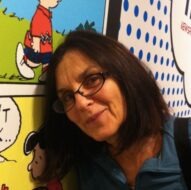
Judith Shapiro is a DC writer who spends a lot of time in Hoboken, New Jersey staring at the New York skyline. When the memoir she’s writing looks the other way, she secretly delights in flash prose and poetry. A Pushcart Prize nominee, her work appears in The Citron Review, The New York Times, The McNeese Review, Bending Genres, The Sun, and elsewhere.