
CONTRIBUTOR SPOTLIGHT:
Interview with Ehsan Ahmed Mehedi
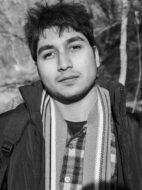
Rappahannock Review Poetry Editors: We loved your last line: “I do not know how to act out love.” Love is never explicitly mentioned throughout the piece until that end line. Why did you feel it important to end with?
Ehsan Ahmed Mehedi: Back when I was working on the poem, I had been thinking a lot about observing the flow of emotions instead of reacting upon or letting them influence any actions. Which of course is a monumental task. Most of the time you end up being disinclined to acknowledge the state of your emotion, to deny the terror it may cause, to save oneself from its terrifying reality. And so, to answer the question, I think the title “Abstention” is tied to this point a bit, or is explanatory in a way—which of course I dislike, i.e., I dislike anything explanatory in a poem—but, the point of abstention is that all throughout, the poem abstains from admitting the emotional undercurrent that tries to protrude over and over, and is only admitted at the very end in a moderate and observant way. And at this stage, the admission of the truth “I do not know how to act out love.” is no longer reacted upon but only observed, parallel to the observation of the external landscape. And the arrival to this point might catapult further revelations which deserve further attention, and so I felt like the poem had to end, because it was getting more and more demanding to continue.
RR: Throughout the piece, the poetic speaker jumps to several topics, rarely lingering on any one specific moment. However, unlike other references, the poetic speaker often returns to ideas surrounding the human body and trees. Why were those ideas important to return to?
EAM: Yes, I think jumping around topics is one of the mechanisms the poem employs to avoid attending to the immediate undercurrent of emotions. Yet despite the efforts, all things seem to point towards the very thing you are trying not to look at. And the penultimate sentence, which extends among the last three couplets of the poem, draws the attention of the speaker to a single landscape long enough to ignite the admission which thus far has been protruding but ignored. However, I honestly do not know why the images of trees and the human body were important to return to, it may be that they are entirely unimportant. The poem seemed to tell me some things as I worked on it, yet so many things in the poem I cannot make sense of. While I myself came to this country a few months before winter last year, and past Fall, seeing how the trees became staggeringly naked (I am again using an adjective adjacent to the human body), which I never saw before growing up in South Asia, left striking impressions on me. I always loved trees, I never felt alone in the woods. The sight of trees in their varying states always affects an impressionistic awe in me. There was also a constant presence of a person in my mind at that time. And I was reading Then the War by Carl Philips. There are poems in that collection which beautifully articulate my own obsession for trees.
RR: Your use of enjambment is striking. Your lines are rarely endstopped. We were particularly wowed by the line “Dear dog. Dear / human being.” How do you see your use of enjambment operating within the piece?
EAM: My professor Mark Levine once called my line breaks “off-kilter.” Sometimes there is a pushed force that I seem to employ when breaking lines, and I like the propulsion it creates. In this particular case, I think the forced enjambment speaks to how distant the movement is from “Dear dog” to “Dear human being”. The man and his dear dog are present, the “Dear human being” is not. There is also the force attached to “Dear” due to the enjambment—so much like an insistence that the human being is a dear one, whereas the dog being dear to the man is taken for granted. I do like to pay a lot of attention to my line breaks and enjambments. I enjoy the many possibilities a tantalizing jump can offer.
RR: Your bio mentions you being a visual artist. There are several moments in this piece where color is mentioned. Do you find that being a visual artist influences the way you place color in a poem?
EM: That is a very interesting and subtle observation. By visual art I mean to say photography & collage. I wish I could just say “photographer” instead of “visual artist” but to include my love for making digital collages, I resort to that term. I hope it doesn’t misconstrue my intention. Although generally a visual artist involved in color as primary material would certainly be more aware of color palettes in their writing too. But for me, I am more aware of images in my poem than colors, although I do suppose colors are very frequent in the images I construct. I am very visually driven, I am motivated by the seen things, and so many of my poems come from that slower observation of the outside world, be it flat shades or gradients, mosaic fresco of the flora, the landscapes, really the landscapes. So, to answer the question, yes, being a visual artist does influence the way I work with images in my poetry.
RR: Do you have a favorite line or moment within this poem that you would like to expand upon?
EAM: No.