
CONTRIBUTOR SPOTLIGHT:
Interview with Emi Miyaoka
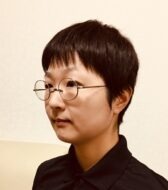
Rappahannock Review Poetry Editors: In the first stanza, the poetic speaker states that “Poetry piled up within me […] ultimately talks about nothing” This line discounting the poetry within the speaker, is itself, within a poem. Why did you choose to open your Tanka with this line?
Emi Miyaoka: I am deeply attached to this opening line. It expresses a primal, inward sensation that arises when I encounter nature and the vastness of the universe. Poetic language—or rather, the feelings that precede it—seems to drift down from a distant sky like snow, quietly accumulating within me. Over time, only a small portion crystallizes into poetic words. For me, nature stands apart from human intention or assertion; it exists as an undeniable reality, prior to interpretation. Nature itself makes no claims and neither thinks nor speaks of the future. One might say that nature “speaks,” but it is only through human presence that we give it voice and meaning.
In this tanka, I am listening closely, trying to apprehend nature before it becomes language. Human beings shape thought and language from both the outer world of nature and their inner world. In that sense, this tanka captures a very early stage of the creative process. It does not discount the poetry within the speaker that later takes form through intention. Rather, it suggests that writing poetry is also an act of being with nature.
In the Heian period (8th–12th centuries), Japanese literature was shaped by a sensibility known as “Aware”, a refined and delicate emotional responsiveness deeply tied to nature. I sometimes imagine that we might still glimpse something of that sensibility today.
RR: The first half of the poem employs a somber mood through references of the speaker’s poetry “talk[ing] about nothing” and all the other people in the speaker’s life “burning whitely / as they live their lives” How would you describe the journey of emotion through this poem?
EM: Rather than somberness, I intended to express the joy of being alive!
“Talking about nothing” describes an encounter with primordial nature. It may seem stark, even unsettling, but for me it marks a moment of dissolving into nature—an essential and meaningful line. “Burning whitely,” on the other hand, evokes each person as a star, shining in the sky and expending their one and only life to the fullest. In reality, human beings live by burning energy within about 37 trillions of cells: a white, incandescent flame that exists only once.
The objectivity of nature differs from the gentle warmth of human life. Yet we, as fragile and short-lived beings, are drawn to the vast depth of nature.
This tanka collection begins by listening to primordial nature. As it progresses, human elements gradually increase, leading to the final tanka, which depicts a meaningful human connection.
RR: The Tanka is a strict form, following a 5/7/5/7/7 syllable structure. The English translation of Tanka “Snow Falling” does not follow this syllable structure, yet it is labeled a Tanka regardless. Tell us about the expectation of the form between languages and how you decided to navigate them.
EM: In English versions, the lines take the form of free-verse Tanka. This reflects my decision to prioritize meaning over syllabic structure in translation. As a result, the English versions may appear closer to short free verse than to traditional Tanka.
In Japanese versions, most of the Tanka follow the 5/7/5/7/7 pattern, with only one exception. What feels natural in Japanese can become restrictive in English when clarity of meaning is the priority. To be candid, this is also an area in which I continue to develop my language skills.
Whether to privilege form depends less on the language itself and more on the poet’s individual approach. Some poets thrive within formal constraints; others do not. In contemporary Japan, many poets also write free-verse Tanka.
In navigating this difference, I focused on conveying meaning. The nuances of Japanese cannot be fully carried over into English, so I regard the Japanese and English versions as distinct works, much like free verse. Even so, I believe the core of the Tanka can be preserved across languages through careful attention to meaning.
RR: You have submitted a number of beautiful poems throughout your writing career. You’ve submitted some poems solely in English, and some poems solely in Japanese. How do you see both languages functioning within Tanka “Snow Falling” in terms of meter and theme?
EM: I have been told that my Japanese poetry has a distinctive rhythm. This likely stems from the 5/7/5 pattern, which I have internalized since childhood. That rhythm has become deeply ingrained in me and naturally appears in my Japanese writing.
In English, however, I prioritize meaning over rhythm. While I hope to develop a stronger command of English prosody, I am reluctant to sacrifice meaning for the sake of form. I want to convey the ideas and emotions within the poem and Tanka, even if this results in a more analytical tone.
In “Snow Falling”, some of the English Tanka incorporate rhymes. Because they are arranged in three or four lines, rhyme becomes possible—something not typically found in Japanese Tanka, which are written in a single line.
This may be true only of “Snow Falling,” but while English and Japanese differ in rhythm, they are not so far apart in terms of theme. Even when their forms diverge, I hope to preserve the core of the work. Ideally, readers in both languages will arrive at a similar impression.
RR: This poem mentions Nietzsche and Kant. Have they, or other philosophers, influenced your everyday life?
EM: The tanka that references Nietzsche and Kant is based on a personal experience. After visiting a bookstore, I hesitated over whether to make a purchase, so I decided to take a break and think it over while eating ramen. My memory is unclear, but I may have ended up buying Kant’s Perpetual Peace, a work that later informed the philosophical foundations of the United Nations. In this way, philosophy has a tangible influence on our lives. While the United Nations faces many challenges today, I am deeply moved by the ideals on which it was founded.
For me, philosophy—as a discipline that allows us to think in pure concepts—is essential. It supports the mind and helps us become more fully human. At the same time, I am particularly interested in the practical influence of philosophical ideas. In Japan, Nietzsche, for instance, is sometimes introduced to medical students. The concept of the “Overman/Übermensch.” Such examples suggest that philosophy continues to shape my thinking in concrete ways. Philosophy, as a mode of pure thought and as a system of concepts, is also profound and deeply compelling.