
CONTRIBUTOR SPOTLIGHT:
Interview with Kenton K Yee
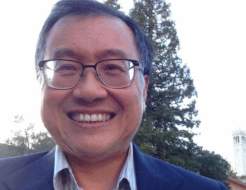
Rappahannock Review Interview Editor: “Odysseus as an Albone” rewrites the cycle of a Greek epic, like the Odyssey, as the life of a sea snail. What inspired you to make this connection?
Kenton K Yee: I was going for a persona poem in the voice of a shellfish. After drafting it, I noticed the abalone was courageous and persevering but also calculating and vengeful. Tying him to Odysseus is a shorthand way of saying he’s a warrior, tough and capable of “I can rise; do the same to you.” In short, I chose the title—as I usually do—AFTER drafting and examining the poem. My knowledge of Greek mythology comes mostly from what little I remember from translating into English Virgil’s epic poem, “The Aeneid,” during my four-year prep-school Latin class. The Aeneid builds on Homer’s “The Odyssey,” but it refers to Odysseus by his Roman name, Ulysses, whom James Joyce titled his renowned novel after. Like the protagonists in “The Odyssey” and Joyce’s “Ulysses,” the abalone in my poem is a warrior-sojourner whose ultimate goal is to return home. So the title “Odysseus as an Abalone” seemed appropriate.
RR: You chose to use harsh action words like “yanked,” “pried,” and “smashed” throughout the poem. What are you conveying with these word choices?
KY: Violence—not just physical but also psychological, emotional, and environmental. Often, psychological and emotional violence causes just as much, if not more, damage than a physical beating. We typically imagine violence to happen at home or on the streets, but just as much, if not more, psychological and emotional violence can happen at school or work.
RR: Why did you choose to write from the perspective of the abalone rather than the human that consumes it?
KY: I wanted to use the abalone’s point of view to convey the victim’s experience—the human experience. Ironically, the human doing the beating and consuming, like a large organization or government, may not even be aware of or care about the violence it’s inflicting.
RR: Have you ever dabbled in other genres, or are you strictly a poet?
KY: I started creative writing as a prose and novel writer almost 15 years ago and still am trying to polish off a novel. I didn’t take up poetry writing until the pandemic years, and
after taking it up, I got hooked. I still write fiction, but I spend at least half my writing time writing poetry now. Tickled that my first book accepted for publication is a poetry chapbook (Bull City Press, due in 2027).
RR: Could you give us a little insight into what your book will be about?
Nothing’s final yet. At this point, I think of it as a collection of self-portrait poems adding up to a more complete cubist self-portrait. So you could say my chapbook is a cubist self-portrait of an aspiring artist as a young man working his way through several false starts—like Joyce’s Stephen Dedalus character. Unlike Dedalus, my persona narrator’s false starts were in math, science, law, and business before he recognized his artistic side. I myself majored in mathematics and began my career as a theoretical physicist long before I started writing.
RR: What is your favorite type of seafood to eat?
KY: I love abalone, but fresh abalone isn’t readily available in California supermarkets. (What I know about shucking abalone comes from watching YouTube videos.) However, fresh locally caught Dungeness crab is widely available each fall and was my favorite meat growing up in San Francisco, so steamed whole crab is my comfort food. When given a choice, I always choose fresh steamed seafood over red, fried, or processed meat.