
CONTRIBUTOR SPOTLIGHT:
Interview with Caroline Huckeba
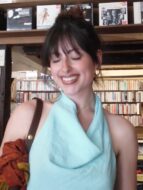
Rappahannock Review Interviews Editor: “Dinner and a Show” discusses your time spent in an eating disorder recovery center. Do you think that the current conversations and trends around body positivity or the opposite lead you to write about this or affect the way you wrote about your experience?
Caroline Huckeba: Yes, I think the current conversations around body image and body positivity influenced how I wrote about my experience more than whether I wrote about it. I was very conscious of not wanting to glamorize eating disorders, so I approached the writing with caution and honesty. At the same time, being in a recovery center where every patient was a woman made me realize how little awareness there is for men with eating disorders. Online, most body image conversations are framed around women, and that narrow focus had shaped my own understanding. It wasn’t until treatment that I recognized how the lack of awareness prevents many men from seeking help in the first place.
RR: You have a humorous, tongue-in-cheek/sarcastic tone throughout the story. Is this similar to how you felt throughout this process, or a tone adopted while looking back at the experience?
CH: The tone was definitely something I adopted while looking back. At the time, I had full-blown “eating disorder brain”—completely depleted, detached, and running on about one thought per hour. I was too dissociated to grasp how absurd the environment actually was. Only in hindsight could I see the chaos of it all. Like, if I was already struggling to eat, why on earth would you hand me a stale microwavable quesadilla and then have someone watch me eat it?
RR: A lot of this story does feel very out of body or from a third-person view. Why did you decide against writing in that “eating disorder brain” you mentioned?
CH: I chose not to write from that “eating disorder brain” because I wanted to tell the story from a perspective that has had time to separate, heal, and reflect. In the moment, I had almost no self-awareness, yet at the same time, I was hyper-focused on myself in an unhelpful, distorted way. Writing from that mindset wouldn’t have created something I could responsibly share with an audience. I needed distance.
As for the out-of-body tone, a lot of that comes naturally from the fact that the whole period is blurry to look back on. I was struggling so much that many moments felt dreamlike or half-remembered. The clarity that came with recovery allowed me to revisit those scenes with a fuller understanding, instead of recreating the fog, panic, and confusion I was living in at the time. By writing from that distance, I can show the disordered thinking for what it was: irrational, consuming, and often absurd, rather than accidentally promoting it.
RR: Why do you think the word association game sticks out most to you from your time at the recovery facility? And what was your interest in making it the opening scene of your piece?
CH: The word association game sticks out to me because it was meant to distract us from the act of eating. to keep our eyes on our plates and our thoughts somewhere else, but it never really worked. People would be guessing movie titles while others gagged over their food or rocked back and forth, crying. I remember just sitting there, feeling miles away from the room I was in. What also made it memorable was how familiar the game felt—everyone there was a woman around my age, raised on the same movies, songs, and celebrities. Talking about those things almost made it feel like we were just a typical, fun group of girls having a dimly lit dinner together, not a group of girls who’d just had their vitals taken.
RR: With your BS in psychology, do you think obtaining that was influenced by your time in the recovery facility, and does it help you write more easily about something like this one?
CH: My psychology studies have definitely influenced my writing. I still remember sitting through Abnormal Psychology after recovery and learning about eating disorders from a clinical perspective—it was surreal to see my own experience reflected in a textbook. I think my degree has helped me most with learning how to ask questions, since so much of psychology is rooted in research and inquiry. Once I was in a stable enough place, I started asking myself: what about me was keeping me sick? Was it the pattern, the cycle, the mindset? Or had I already decided it was a losing battle? Studying CBT (cognitive behavioral therapy) also helped me understand how cognition drives behavior, and how changing thought patterns can reshape those behaviors, something that’s deeply influenced how I approach both recovery and writing.
RR: Do you plan on writing any other stories that combine your love of writing with your background in psychology?
CH: I do. I’m really interested in the places where psychology and storytelling meet, the hidden mechanics of human emotion. Psychology tries to figure out why we do what we do, why we feel certain things, and how our brains and experiences shape us. It’s a scientific study. But writing lets me explore the part of emotion that science can’t fully explain, the part that feels like a kind of magic. Our love is magic, our sadness is magic, even our happiness is magic. There are no “bad” emotions; each one reveals a small spark of that secret, unexplainable magic inside us. That mystery is something I want to keep writing toward.
RR: Do you tend to lean towards non-fiction in your personal reading, and if so, are there any authors you take inspiration from?
CH: My favorite branch of nonfiction is writing centered on mental health. One of my biggest inspirations is Jen Soriano. I read her book Nervous in a creative nonfiction workshop, and it completely changed the way I thought about structure. She tells true stories through song, research, and call-and-response, and she does it with such grace and respect for everyone involved. I actually got to attend a public reading and asked her how, when writing about sensitive topics like mental health, she decides what’s too much to share. She told me, “People will always ask for more,” which really stuck with me. Outside of nonfiction, I’m a big fan of contemporary, character-driven fiction by women. My favorite novel I’ve read this year has been The Coin by Yasmin Zaher.