
CONTRIBUTOR SPOTLIGHT:
Interview with Andreas Fleps
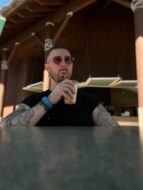
Rappahannock Review Interviews Editor: The focus of “Neon Altar” is the contrast between your time spent at your religious school with the teen nightclub. How did you first discover the night club, and was your religious experience there immediate?
Andreas Fleps: I knew about the club because my brother had frequented it. My brother is eight years older than I am, and I have a montage in my head of sitting on his bed and watching him get ready to go out on Saturday nights, desperately wishing I could go with him. To raise the energy, he’d have techno playing on his stereo as he opened his closet door to choose a button-up, which sometimes he let me pick. He’d put his silver hoop earrings in and then go to the bathroom to grab his hair gel, using half of the container to slick back his black, curly hair. Last, he would ordain himself in an ungodly amount of Giorgio Armani’s Acqua Di Giò.
He was always so excited to go, and I was always sad when he left, as his friends arrived and they would pack themselves into his black 2000 Toyota Celica, and I would listen to the diminishing thump, thump, thump of his car’s speakers as it headed down the street… I couldn’t wait to turn sixteen! I suppose it’s the classic story of a younger brother wanting to be like his big brother. I thought he was the coolest guy in the world. I still do.
In terms of the religious experience at the club, I can’t say I saw it as religious in nature at the time. It’s language I can impose on my experience only when looking back. In some ways, it’s the opposite of what happened to Lot’s wife in the Book of Genesis—she was told by God not to look back at Sodom, an irredeemable place of sin, and when she did, she got turned into a pillar of salt. But when I looked back at what had been deemed sinful, I caught a glimpse of the divine.
RR: You have a very strong voice throughout the piece, and the imagery is very vivid. Is this something that comes naturally to you when writing, or is it a more complicated process?
AF: As it is for any writer, a strong voice is something that’s constructed over time. Each day in a writer’s life is just practice. A line of a poem or a sentence in a story, well-written or not, prepares you and helps inform how you will address the next line or sentence, and on and on the process goes. I often think writing is a lot like bodybuilding. A muscle gains strength by lifting ever heavier weights, and what weighs more than our stories?
As well, to have a strong voice, a writer must stay true to the musicality of their language. You don’t want to write like somebody else—they are busy playing a different song. Of course, we will always have our influences, but a strong voice knows how to extract what it loves from another’s writing and infuse it with its own rhythm and notes. It’s the same with imagery. I’m a writer because I want to articulate how I’m perceiving my life and the lives around me. We’re all looking at the same world, but we’re each witnessing and experiencing drastically different things. A pair of eyes can catch a detail that billions of others might have missed. That’s why poetry can be so powerful and transformative—poets train themselves to notice the miraculous in the quotidian, and even, when brave enough, in the horrors that wind through our lives like rivers.
RR: You studied theology and philosophy at Dominican University. What is your relationship with religion now, years after your experiences at Zero Gravity?
AF: As a joke, I often tell people I’m a nihilistic mystic; it just depends on the day, minute, or second. I can’t say I believe in God—either as a literal being or as that which is manifested through the act of love itself. Human love is sacred enough for me, though I still think about Jesus a lot. He’s my Holy Ghost. But I continue to engage with the Bible regularly, and its stories never get old to me.
I think more people should read and study the major religions’ texts, especially those inclined to atheism, because although you might be done with religion, if people continue to believe, religion isn’t done with the world. Charles Baudelaire said, “God is the only being who, in order to reign, doesn’t even need to exist.” And there will always be people using the name of God or weaponizing his Word to fulfill their personal agendas, often to nefarious ends. What I experienced in high school troubled me, and it’s the reason I wanted to study theology. I was tired of their interpretations, and I kept asking myself if all these people have Christ in their hearts, why is their love shaped like a fist, raised at anyone deemed as other?
RR: Was there a specific moment or revelation that inspired you to write this piece?
AF: The piece started as just a few fragments of poetry, one of them being, “I wanted to be like a turtle, capable of curling back into my own hands of God.” Then, one night after seeing a movie with my brother, he brought up Zero Gravity, and as the conversation progressed, I found myself talking just as much about my experiences in high school—the contrast I had struggled with between what was designated as sacred and what was defined as profane, and how the profane ended up holding holiness more gently than a church or doctrine.
There’s a quote that I ended up not putting in the piece, but that heavily influenced me as I wrote it. In De Profundis, Oscar Wilde states: “The world had always loved the Saint as being the nearest possible approach to the perfection of God. Christ, through some divine instinct in him, seems to have always loved the sinner as being the nearest possible approach to the perfection of man. …But in a manner not yet understood of the world, he regarded sin and suffering as being in themselves beautiful, holy things… It sounds like a very dangerous idea. It is—all great ideas are dangerous.”
RR: It seems like the admiration you had for your brother influenced your draw to the teen club. Why did you choose to omit his influence from this piece?
AF: To be honest, I didn’t even think of incorporating it, so thank you for asking the question! It was nice to recall; nostalgia can be like sitting next to a cozy fireplace on a winter’s day. It reminded me that I need to try to be more grateful for the memories of mine whose rooms provide warmth, because I tend to focus on the negative aspects of remembrance. Maybe writing “Neon Altar” was a way to rebel against that propensity. Yes, I had a tough time in high school, and often felt alone, but blessings still found me—they have a funny way of doing that.
RR: Your bio mentions that you also write poetry. Was “Neon Altar” your first dabble into nonfiction, or is that your preferred genre?
AF: Yes, “Neon Altar” was the first nonfiction piece I sought to get published. It’s a medium I haven’t utilized often, but I find my work gravitating towards prose. Granted, I’m far more comfortable writing poetry because it’s what I use every day to help me process the world’s brokenness and the broken worlds inside me. Poetry is my lifelong prayer. But I think I only wrote poetry for the longest time because I had sold myself the lie that I didn’t possess the linguistic endurance for prose. I didn’t believe in myself enough to even attempt a creative essay or a short story, so it’s been a lot of fun proving myself wrong and exploring the new vessels that can aid in carrying my story. I think every writer has their bread and butter, but like anything in life, it does us good to get out of our comfort zones—it’s how we discover new possibilities, grow, and keep the imagination from growing stagnant. It’s fascinating to me, the ways in which we can continuously surprise ourselves.