
ISSUE 13.1
FALL 2025
welcome
issue contents
> fiction
> nonfiction
> poetry
> art
contributors
interviews
our editors
Ashiwni Shenoy
In Search of Death
“This is the elixir of your life, my child. Drink quickly,” Dai Ma whispered as she tipped two spoonfuls from the black pot into my mouth. I was too young to understand what she meant. I hated the blue syrup that gleamed like liquid sapphires in the moonlight but tasted like the bitterest neem mixed with honey. It wasn’t just the taste that haunted me; it was what came after. I knew that sleep would evade me that night, and by morning, I’d be too weak to play with the other girls. My chest would ache, my throat would be parched, and it would take over a fortnight to feel whole again, only for the next dose to come. The syrup left me drained and furious. It scorched my insides, filled me with a violent urge to tear and destroy. And each month, it was the same.
“How much longer do I have to drink this, Dai Ma?” I would ask, month after month. She always answered the same.
“A few more months, dear,” she’d say, never meeting my eyes. Even as a child, I knew she was a terrible liar, that old woman. She would seal the black pot with a careful hand and hand it to the royal servant to be carried away. Then, with deliberate movements, she would dip the spoon into another pot of bubbling white liquid, the cleanser.
“Go to your room and sleep, my child. You need rest,” she’d say, her voice gentle yet firm. We were in her chamber, nestled in the backyard of the palace where I had lived for the last several years with eight other girls. Dai Ma’s quarters felt more like home than the palace itself. I loved her dearly; she was the only mother I had ever known.
I rose from the floor, dusted off my silk skirt, and bowed to her as I’d been taught. Then I stepped out, expecting the winter breeze to soothe the fever that rose within. But it didn’t. My skin flushed hot, my forehead damp with sweat, and my legs seemed to melt beneath me. My heart thundered in my chest. I ran, stumbling toward the palace, desperate to reach my room before a guard saw me writhing in silent agony.
Even now, it’s hard to believe that someone as pure-hearted as Dai Ma could play a role in this. She was part of a vision, a brainchild of Kautilya, a cunning strategist, a master of schemes whose genius lay in manipulating fate itself. Under his direction, assassins were crafted from innocent, orphaned girls, bought and sold by the rich and powerful. Poison damsels trained to lure their targets into welcoming death with open arms. Cold-blooded killers, wielding no weapons, only a heart of stone and venom coursing through their veins.
*
2300 years later, Karmadwadi, Karnataka-Maharashtra border.
I woke up this morning, knowing it was time to leave. When you’ve lived for over two thousand years, you learn to read the signs—the subtle whispers from the trees, the piercing sun rays, the direction of the wind. Hints from mother nature, urging the overstaying guest to move on.
I’ve spent the last thirty years in this little village as a healer, helping people with ailments of the mind and body. I’ve shared my medicines to soothe their pains and my stories to calm their troubled minds. I’m the one they seek first, and the one they turn to when all else fails. There is so much one can learn when time is unlimited. I speak many languages— of words, of signs and of eyes. I have studied plants, flowers, medicine and people.
The men find their reasons to visit my shop, while the women detest me. Women know things that cannot be explained—an intuition that warns them to protect themselves and their loved ones. The venom, still pulsing through my veins after all these years, continues its work, drawing the unwary to me. It has also kept my skin soft, my eyes bright, and my youth untouched by time, never a day older than sixteen.
I look in the mirror on the wall and once again see nothing. The mirror shows only the worthy—not someone who has defied nature and linger on only because even death refuses to claim her.
I glance around the shop, filled with carefully chosen books and herbs I’ve collected over the last twenty years. I’ve read every page, tended each plant in the garden out back, and crafted each remedy with my own hands. Yet I know their textures—the softness of leather-bound covers, the stickiness of fresh aloe—only through my imagination.
My hands are always gloved; even the tiniest paper cut or prick could be fatal to another. You see, it’s not just my blood that harbors venom. Every cell in my body is a weapon of its own, each touch a potential death sentence. My nails and hair are the most potent; I trim them only on full moon nights when the venom is weakest, and then burn them in a ritual fire made with sage, neem, and black turmeric.
Sometimes, I dream of creating a grand pyre from this potent fire and stepping into it, hoping it would grant me the sweet release I’ve sought for centuries. But then I fear the fire, too, will reject me as the mirror does, leaving me trapped in a burnt shell for eternity. So, until I am certain that something will truly set me free, I drift from place to place— a restless soul endlessly wandering, in search of death.
With a sigh, I reach up to bring the boxes down from the loft. It’s time to start sorting through everything. The books I’ll donate to the local library and set aside a few for my favorite customers. Most of the herbs, though, will come with me. But what of the garden? I wonder who will care for it when I’m gone.
The little bell above the door chimes and I turn around. My first customer for the day is Kamal, a fourteen-year-old boy who has made books his life and my shop his safe haven. Shy at first, he opens up when I ask about his current read or what he’s working on. He even let me read his short story once, and I can see him becoming a great writer someday. But I worry that books have become more of a safety wall between him and the world.
Today, though, something feels different. He walks in with a box of books, his whole world, as far as he’s concerned.
“I want to return them,” he says, placing the box on the counter. I frown. “I don’t want any money in exchange. Just make sure they’re taken care of,” he adds, his smile unusually wide. I study him for a long moment before I invite him to stay for tea. He hesitates but agrees.
I prepare two cups of my special herbal tea, adding a little extra honey to his, and motion for him to sit. I watch him take a sip, closing his eyes as the warmth of the tea seems to settle inside him. I almost feel the honey working its magic through his chest. After what seems like hours, he finally opens his eyes, and I notice they are bloodshot.
“You can talk to me,” I say softly. “I’ll keep it a secret.”
His face crumples, as though no one has ever said something like that to him before. Tears spill freely, and he begins to share his story—his life at school, the boys who are monsters in disguise, and how he’s motherless with a father who’s always away. I listen, offering the comfort of my presence, and with each sip of the tea, it seems that more of his pain flows out, lightening the weight on his heart. By the end, I see something shift in his eyes. He’s changed his mind.
He stands, thanking me quietly for the tea, and turns toward the door. “Don’t you want your books back?” I ask.
He pauses, a small smile tugging at the corners of his lips as he picks up the box. I walk over and place a book into the box. The Room on the Roof. It’s about a teenage boy who, like Kamal, once felt like he didn’t belong, until he found the friends who changed everything.
*
In the evening, the bell chimes again, and I smile, recognizing the visitor before I turn. Laila. I always sense her presence as if we’re connected by an invisible tether. She cannot see me, and I cannot touch her, our bond woven entirely from words.
“Brinda.” Laila’s soft voice fills the room, and that strange, aching clench tightens in my chest once again. It happens every time she speaks my name. As I said, there’s a connection—perhaps from another lifetime or some parallel world where I am as human as she is.
When you have lived as long as I have, your desires eventually fade. I have tasted every cuisine, wandered to every place worth visiting, devoured all the books that once intrigued me, and indulged in every pleasure known to humankind. All but one: love—not the kind so often romanticized between lovers, but the quiet, steady love taken for granted—the bond between mother and child. I never knew that love. I was an orphan for as long as I can remember, my mother’s face an enigma, her presence only an ache I learned to carry.
Once, I was briefly married. I was only ten, and my husband was three times my age. He died mere days after our wedding, making me an ideal candidate for the Master’s plans. My stars, they said, were aligned for immortality. The Master’s secret search swept across the land, gathering orphaned-widowed-virgin girls like me, those unbound and unnoticed. That’s how I met Dai Ma, who became the mother I never had.
But that bond was shattered the day I first bled. My body betrayed me, consumed by the poison that had built up in my veins after years of carefully measured doses. It surged through me like fire, reshaping me into something both lethal and eternal. I nearly died that day, reborn as the poison’s host, bound to it forever. I never saw Dai Ma again after that day.
I turn around, blinking back the tears that never come. Laila stands there in a beautiful frock with embroidered flowers and buttons, her small hand clasped in her father’s, who regards me with a faint frown. “Need some help?” he asks, gesturing to the boxes piled high around me.
“No, I’ll manage,” I reply softly. Farhan’s gentle smile and the kindness in his eyes make him the sort of man any woman might dream of building a life with. In another world, we could have been a family. I offer him a faint smile, but he looks away, as though sensing something unsaid.
I want to tell him I’m leaving, but I can’t. I never do. It’s easier this way—leaving without notice, breaking all ties and moving to a place where no one knows me. A new beginning far from familiar faces. It is safe for everyone.
“It’s my birthday today.” Laila’s words break our trance. Farhan clears his throat and lifts her so I can see her better. She proudly holds up her colorful pinwheel, its vibrant hues spinning in the air. My heart clenches as I realize that six-year-old Laila can only see the color black. Farhan catches the flicker of sadness in my eyes.
“You look so pretty, Laila. I love your dress,” I say quickly, trying to push the ache aside. I reach into the jar on the counter and hand her a sweet treat. “Happy Birthday, Laila.”
Then it’s time for the stories. Laila, as always, walks to her favorite chair in the corner. She inhales deeply, taking in the familiar scent of old pages and worn leather. She knows this place by touch—the books, the shelves, the cozy corner where she sits. With the patience only a child who sees with her heart could have, she waits for me to begin.
Every Thursday, Laila and Farhan come by. Farhan leaves to the market to buy groceries while Laila insists I entertain her with a story or two. I turn the sign on the door to ‘closed’ and, with a small sigh, pick up Malgudi Days from the shelf. Time slows as I read to her this week’s story from a town not unlike ours, and for that hour, the weight of my own world lightens.
*
When Farhan returns to pick up Laila, I notice the bags filled with new clothes and jewelry. I pretend not to, quietly placing the book back on the shelf and returning to the counter. I have known Laila for over a year now. Every Thursday Farhan and Laila visit the shop. Farhan and I exchange pleasantries, our silence speaking more than our words and then he leaves to run errands while Laila and I have the story hour. Sometimes, Laila tells me about their home and their life. She never met her mother, Amra, who passed away in childbirth. Farhan never remarried for Laila’s sake.
“We’ll have to skip next week’s story hour,” Farhan says, pursing his lips. I don’t ask why. I simply nod in acknowledgment.
“We’re going to meet my new mother,” Laila announces. My eyes snap up, betraying me, to meet Farhan’s gaze, which seems to say I couldn’t wait forever. I nod once more, forcing a smile. “Congratulations.”
That night, sleep eludes me. I get up from my bed at the back of the shop and return with a vial of lavender oil. I dab some on my pillow, lie down again, and inhale deeply, trying to calm my restless nerves. A bitter laugh escapes me—after all these centuries, I still haven’t learned how to deal with heartbreak.
I watch the moon through my window and wonder what Farhan would have thought of my reaction. Did he truly believe he held my heart in his grasp? He wouldn’t be entirely wrong if he did—I may have given him mixed signals. But my heart aches not for him, but for Laila. For her, in my bravest moments, I dare to imagine a family. A sense of permanence. A place to belong.
I wonder what made Farhan change his mind. Will this new mother care for Laila? Or has he been blinded by the pull of flesh and companionship? What if this new mother resents Laila? How often does one fully accept a child not bound by blood? Especially one like Laila, blind and fragile. I must make sure she’ll be all right before I leave. I need to postpone my plan.
The next morning, I leave the shop closed. Instead, I slip out through the backdoor and head down the lane to find the newspaper delivery man, Amarnath. I buy a newspaper, exchanging pleasantries as I do. I catch the look in his eye—the one all men seem to give me. In that moment, I know he’ll tell me anything I want to know.
“I hear there’s a wedding in order,” I say, casually flipping through the newspaper. If anyone knows the village’s secrets before they become public, it’s Amarnath. His news is often juicier than anything in the papers he delivers.
“Oh, yes,” he beams, “Ruksana, the grocery shop owner’s niece, is marrying the father of the blind girl, I hear.” I cringe at the way he refers to Laila but say nothing. I nod, feigning disinterest, eyes still on the paper. Eager to please, he searches his memory for more details, tidbits picked up on his rounds.
“Ruksana was married before, but her husband died of TB,” he adds, clucking his tongue. “She is very young, good for Farhan. Might not be good for the little one, though. Stepmothers can be hard, even if you’re normal.”
At mid-day, I take the bus to Ruksana’s neighborhood. Thanks to Amarnath’s resourcefulness, I know every detail of her life and her family’s history, stretching back three generations.
I wait outside her house, hiding in the shadow of a neem tree. From there, I observe the women of her family moving in and out of the balcony. They’re strikingly beautiful, with delicate features untouched by the sun or hardship—features that seem foreign, like a trace of ancestry from some distant land. The house itself is grand and artistically crafted. It’s clear her family is wealthy, and I can already see Farhan become a puppet in their hands. The rich have a way of ruling over others, even when the others are not destitute.
Then, I see Ruksana’s mother step into the garden. I move closer, just enough to reveal my face from under my shawl, letting a faint smile play on my lips. I approach the compound wall, close enough for her to see me clearly. Her eyes widen; her smile fades. I open my palms, blowing softly, releasing the faint scent of crushed herbs to drift toward her.
I tell her about Farhan, Laila, and myself. I describe our unusual family, my aegis over Laila, and how any harm directed at the child would bring great suffering to the one who inflicts it. My words are soft but carry a clear warning. Then, I plant a vision of Ruksana’s future in her mind—one no mother would wish for her daughter. In that moment, we are two mothers, looking into each other’s eyes, each wondering what destiny holds for our daughters.
*
The next day, Sheela walks into the shop, and a wave of nervous jitters stirs in my stomach. She is the closest thing I have to an acquaintance, here in this village or anywhere else in the world for that matter. Though she’s been in this world only a fraction of the time I’ve spent here, her wise eyes make me wonder if this is her hundredth time, only in a different body. Immortality, it seems, takes many forms.
Sheela appears to be around fifty, though I never ask anyone their age. Sheela is a cowrie diviner, among many other things. She reads people’s futures and uncovers the hidden layers of situations using shells and other tools. She drops by sometimes, just to chat and scan through my bookshelves, but I often catch her zoning out, as if trying to place my shop and me into some timeline in her mind.
I smirked the first time, curious about what she might uncover if she actually did find the right spot for me. But over the years, her deep brown eyes, her carefree gait, and her soft words have earned my respect. Diviner or not, there is something undeniably special about this woman.
“I see you’ve begun to pack,” Sheela says, her voice soft, as she approaches the counter in her slow, deliberate manner. She takes her time scanning the shop, and I almost feel an urge to pull everything into my arms, hiding it from her probing gaze. But I manage to mask my anxiety, pretending to be unaffected.
“But something is pulling you back. Stopping you from leaving,” she continues, standing in front of me, her eyes boring into mine. I fight the instinct to look away, willing my gaze to remain steady, betraying nothing.
“Is it a man?” she asks, and I know it’s just a wild guess. “Or perhaps his child?” Sheela adds, and that’s when I give up. The weight of the last two days presses too heavily on me, and I find myself spilling everything.
“So, you love the child enough to keep a potential mother at bay, but not enough to marry her father?” Sheela summarizes my situation with a knowing look. “Is the man ugly?” she adds with a soft chuckle.
I shake my head, disagreeing, and she frowns in response. “Ah, I see. You blush at the mention of him. So, what’s the problem?”
“I can’t say…” I reply softly, hoping that, in some way, she—who seems as far from human as I am—might understand. She studies my eyes for a moment, then gently takes my gloved hand in hers. I let her touch it, instinctively curling my fingers into a fist to conceal the lethal tips beneath the gloves. Her wrists are adorned with bracelets of colorful beads and cowries, their delicate clinking a soft music as she thinks.
A minute later, she withdraws her hand, mumbling something under her breath, and begins to walk out of the store. Just as she reaches the door, she stops and turns, her eyes locking with mine.
“You know,” she says, her voice softer now, “time changes a lot of things. Even the most fragrant bloom fades with time, and even the deadliest venom loses its sting.”
*
For the rest of the week, Sheela’s words ring in my ears and I begin to look for positive hints in the words of all my customers. Kamal comes to return the book that I had lent him and I see he already feels better. I notice the love in his eyes and feel assured that Laila, too, would love me as a mother—even if I can never hold her in my arms or kiss her good night.
On Thursday, as expected, Farhan and Laila arrive and I see the sadness in Laila’s eyes, the yearning for a mother, the confusion at being deprived of that bond again. I feel guilt prick in my mind. Farhan, on the other hand, seems relieved, or perhaps it is what I want him to feel.
I smile at him and hold his gaze for a long time. We speak with our eyes and for this I don’t need any herbs. I tell him I am happy he is not getting married, I tell him how much I desire to be with him and Laila, I tell him I am ready. I see his broad smile for the first time ever and I feel emotions that had died centuries ago.
A month passes by in happy bliss. The shop becomes our safe haven, the board on the door is more ‘closed’ than ‘open’ and Laila wonders why the story hour is now every other day and stretches for hours. Farhan is a gentleman so he never initiates any intimate gestures but I can see the desire in his eyes. I try to keep the intimacy going through beautiful words, thoughtful gifts and sometimes an illusion with the help of my herbs. It keeps him satisfied. As long as the herbs are with me, I can make this work.
Laila, on the other hand, is now clumsier than ever. Now that she has realized she has me by her side, she has thrown caution to the wind. Now my hair is tied in a bun, my gloves till my biceps and most of my skin unexposed. Yet, a thousand unpleasant thoughts cross my mind when she touches me, hugs me, clings to my hand or tries to undo my hair. It feels unusual and sometimes makes me sad. I cannot recall the last time someone touched me with such love.
*
A day after the month’s moonless night, as I settle in for my afternoon siesta, the door swings open with a loud thud. I rush to the counter, a smile forming as I see Farhan, but it falters when I notice his red, swollen eyes. He’s been crying. In his arms is Laila, unconscious and pale.
I hurry to them, urging Farhan to lay her on the bench. She can’t lie on my bed, covered in my sweat and remnants.
“She’s had a fever for the last three days,” Farhan explains, his voice cracking. “The doctor gave her medicine, but it didn’t help. This morning, she didn’t wake up. The doctor’s away, and I don’t know what to do.” Farhan collapses to his knees beside her, tears streaming down his face.
I slip on my gloves, my hands moving with practiced precision as I examine Laila’s body for signs of injury. It’s been years—centuries, even—since I’ve seen a wound like the one I’m searching for. And though I haven’t inflicted harm, intentional or otherwise, in a long time, this mark is familiar to me. I could recognize it on a soldier’s battered body, on a month-old, bloated corpse, or even on a decaying animal. Some connections never fade.
Farhan has begun to pray, kneeling on the mat nearby, but I remain unfazed, taking my time to search—because I already know what I’ll find. Then, as I turn Laila over, I see it—the faint, angry blue scratch at the base of her neck. It’s a thin line, barely more than a hair’s width, identifiable only to someone who knows how deceptively small a lethal mark can be.
I check Laila’s pulse, and the cold dread hits me. The poison has spread. It’s been inside her body for days. My stomach churns with anger and fear. How did this happen? I try to recall, but the memories blur, and I’m left with a rising panic I can’t silence.
I steady myself and walk to the medicine cabinet containing the concoction I prepared a month ago, anticipating this very moment. It’s a blend of charcoal dust, Tulsi, Brahmi, the roots of obscure herbs, and ancient chants that I have gathered from distant lands. I spoon the mixture into Laila’s mouth, making sure it reaches her stomach before I place a cloth soaked in charcoal dust over her wound, allowing it to absorb the venom.
Minutes later, Farhan approaches and gently takes Laila’s hand. Her little finger twitches, and his eyes widen in disbelief. Laila is safe, but it will take days before she regains full mobility. The venom has paralyzed her body, but as it slowly withdraws, each organ will stir, and in time, she will be whole again. The process will be agonizing, but she will recover.
As I watch Farhan’s tears and Laila’s confused eyes– her mind struggling to understand what happened– my dream of having a family is shattered by the cold blade of reality. In my longing to be like them, I had forgotten the extent of what I was capable of— what I could do to those around me.
*
Six months passed since the fever that nearly claimed Laila’s life. Each morning since, Farhan has woken up thanking the Lord for sending Brinda to their rescue. Just two days after she saved Laila, he went to the shop, carrying a box of sweets and an intricate saree, ready to ask Brinda to marry him. He had waited too long, hoping she might make the first move, but now he knew: there could be no better wife for him, no better mother for Laila.
But that day, he found the shop shuttered in the middle of the day—a sight he’d never seen in the five years he’d known her. He circled to the back and found the door locked. He asked the neighbors, but no one knew where she’d gone. When he returned to the front, he noticed two boxes filled with books and a sign that read, “Take them for free, but take good care of them.”
After that, Farhan returned daily to find the shop still locked, the stack of books in the boxes dwindling day by day, until eventually, they were gone. The backyard had begun to wither from neglect. He took home a few of Brinda’s favorite flowering pots, hoping to keep a piece of her close.
Over time, he stopped visiting. Some mornings, he’d wake up wondering if Brinda had ever truly been there or if she’d only been a dream. But Laila remembered her better. Sometimes, her small voice would break the silence, asking, “Where did she go?”
“There’s a letter and a parcel,” the house help said, knocking softly on Farhan’s study door before leaving it on the table. Just then Laila stepped into the room, her face nearly back to its bright self, though she still complained of aching joints now and then.
“Who’s it from?” she asked, settling beside Farhan and urging him to read it aloud.
“There’s no name,” he murmured, curiosity prickling. He opened the parcel first, his brows lifting as he pulled out a worn copy of Malgudi Days. He smiled, his heart racing with the certainty that Brinda had finally written to him. He quickly tore open the envelope, and as he unfolded the letter, a familiar scent—the soft, comforting aroma of Brinda’s shop—filled the room. A soft hum began in his head, like distant waves underwater. The room fell silent, and even Laila, usually talkative, seemed entranced by the scent.
“What does it say?” she asked softly, a minute later.
Farhan’s eyes scanned the letter. It was brief, heartbreakingly so. “I’m sorry. Give my love to Laila. Brinda.”
The scent lingered, fading as quickly as it came, and with it, the sharpness of Brinda’s memory began to blur, like sand slipping through his fingers. Farhan felt oddly comforted, as if some heavy, forgotten burden had been lifted. He looked from the letter to Laila, to the worn book on his lap, trying to hold onto the memory of Brinda, but her image already felt distant, like a half-remembered dream.
“Who is Brinda?” Laila asked suddenly, her tone innocent, confused.
Farhan blinked, startled by the question. For a moment, he was unsure. The name felt familiar yet faint, as if it belonged to someone he once knew… or maybe to no one at all.


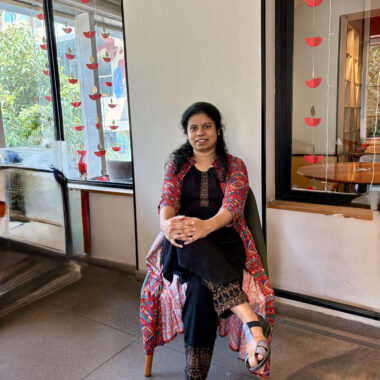
Ashwini Shenoy is an Indian writer, cultural thinker, and storyteller whose work explores the intersection of mythology, contemporary life, and speculative fiction across narrative forms. She is best known for her debut novel, Shikhandini: Warrior Princess of the Mahabharata, which reimagines a lesser-known character’s journey of gender transformation and identity within the great Indian epic. The book has been translated into Tamil, with a Marathi edition to follow.
Her other works include Gift of Life, a story of acceptance and healing during the pandemic, and In the Golden Mountains, a coming-of-age romance. Her experimental short fiction has appeared in Kitaab, MeanPepperVine, and the Sahitya Akademi Journal.