
ISSUE 13.2
SPRING 2026
welcome
issue contents
> fiction
> nonfiction
> poetry
> art
contributors
interviews
our editors
Bruce Crown
The Valley of Obligations The Impressions of Amsterdam’s Canals
Für Clara
Amsterdam greeted me not with the grandeur of its emotional impressionism but with the subtle beauty of its dawn, painting the sky in hues of pink and orange as my plane descended. It took me a long time to learn how to navigate the city, and no map apps could really help unfold the labyrinth of canals and cobblestone streets that promised either adventure, crime, art, exhaustion, or a combination of all four. This was patently obvious from the moment I set foot in the WestCord Hotel, where I was staying. It was close enough to Old Town in the south west of the city; the tram stop that went into the city, Surinameplein, was deserted most mornings when I waited and hoped for the city to unfold before me… but it never did, and wouldn’t for a long time, and soon after I arrived, I found myself suffocated by those winding roads, deep canals, and difficult people.
In those first days, lost among those mazy circles, I wandered the city without destinations in mind and often found myself in a museum or in a peculiarly painted café. There was a sense of vertigo and displacement whenever I caught a glimpse of clichéd tourists looking to smoke weed or having the same conversations about its legalization “back home”—no doubt from North America, or about trips to the red-light district or the appearance of women in bars, cafés, or wandering around in public. Overhearing these conversations got old quick. And other than a book signing at an event by Dennis Bergkamp, I had decided to take a break from one of my main interests: football.
During those early days of autumn, as the city wrapped itself in coveted color palettes that looked like a dream, I stood lost in between the person I had been and the one I wanted to be.
As I found my footing, I realized that perhaps it was me who was regularly hanging out at tourist traps and hangouts where I could not escape poorly spoken English or latent desires for alcohol and sex. This feeling was exacerbated by the fact that the first time I felt true wanderlust, it was in the Van Gogh museum huddled around tourists trying to take the same photo we could simply search up on the internet.
I had just turned the corner from one of the escalators and was reading some quote written by Vincent in a letter to his brother, Theo. I looked past some glass doors where some paintings were placed in the theme of the exhibition: Van Gogh aan het werk—Van Gogh at Work. Being destitute most of his life, I imagined the poster-boy for late-stage capitalism: always productive and at work yet eternally unable to afford even the most basic human needs like food and shelter with relative ease. As I gradually became aware of my surroundings, I noticed a docent or curator simply standing, her attention halved between one of the paintings and a few people who seemed eager for a photo. Frequenting museums, I had noticed some time ago, how these docents move as if strolling in fields of forgotten time amongst dead artists, still paintings, colors clasping out of canvases in front of them while the faces of observers of those colors change. I look at her and imagine what it would be like to be her, this particular docent, with her hair in a golden braid, analyzing the movements of transient beings coming and going by the thousands with each passing month. Tourists must be too facile, too easily satiated by the works, sparing only a few seconds glancing at each painting, while every brushstroke may have taken hours. The tourist is millennia too late, and the museum-goer is blind to boot. The docent feels like a spirit, a phantasmagoria of what it means to exist within art… they seem to survive everything, including tradition and artistic fads.
Someone pushed by me to get through the doors. The air was vibrant with painted walls; everyone moved in the same direction, jolted forward by invisible arrows pointing us to stand by each painting, take a photo, and move on, as if we are out of time in an abattoir. But through one of the windows, the thinnest patch of light penetrated the skylight and rested on this particular docent’s hairclip like a quilt spread over a being alight. I had not yet crossed the threshold into this room yet, I was outside, in between Vincent’s quote: “You should in any case go to the museum often”, and the escalator.
When another person shoved by me to enter the room as fast as possible, smartphone in hand, I was frozen in place. Up until then, I’d tried to gather society—what people do—into a knot of hazy understanding, yet I am jarred by this moment, so much so that I want to leave. I’m suddenly exhausted by this feeling, as if all energy is drained from me. Trying to keep my gaze on the thin sunstrip, I put my foot over the threshold of the doors—now. When I entered the room, I heard nothing. I don’t even hear myself shatter into pieces. It is silent. Only Vincent and the curator are there.
For a moment, I thought I could hear birds singing outside. A stillness overtook me. Suddenly, a child whistled away and left another crying in between the curator and I. He was weeping as if he were lost or heartbroken. He must’ve been placed here by some spirit from a different world. What could a child be crying about here, now? The curator, perhaps like me, had her reverie broken by this boy and began talking to him. My Dutch was still elementary but it felt as if his tears were because a friend or sibling had stolen his Sunflowers pencil worth four euros. He specifically mentioned that it had cost four euros and that his mom had told him it was expensive and to be careful—this I understood in Dutch: vier euro. Four euros! Money, money, money, money! Even in the halls of color painted in destitution, it permeates and demands adulation. This put me a foul mood—it was absurd. How could someone be thinking of four euros in a place like this, full of contradictions, terror, beauty, and magic? If he had lost a shoe or his parents, I would’ve understood. But four euros… I could not even visualize this nor believe that he was weeping. I must’ve hallucinated this, he should just stand there and weep, forever, until the spirit comes and fetches him.
But the curator, as if she was put there by the same spirit, bent down, reached into a little shoulder bag, and gave him an Almonds pen. He grabbed it as if his existence depended on this and disappeared into the crowd. The curator and I locked eyes, then she turned around and stood by the exit.
One patron then asked another where The Potato Eaters was. This voice was so loud it caught my ear, and the curator, whom I realized then was probably more docent than curator, vigilant as ever, popped into the conversation to guide them. She must’ve noticed me listening, because when our eyes locked again, she seemed to include me into the conversation, pointing to the painting directly behind us, lost in a sea of smartphone screens and the flashing yellow square bringing the painting into focus. When she lifted her hand and pointed to the painting, the sunstrip seemed to bend and reflect off a beautiful golden ring she was wearing on her right index finger.
Then I felt caged by the irony, that the world which had always abused the meek, and turned a citadel of leaves and skies into a furnace and factory, would abide by the elation of a tourist (or a hundred) taking pictures of a painting of a family who could barely afford potatoes, painted by an artist who could only barely afford paint and a canvas.
It was in this suffocation that I left the museum. There was an astonishment that all this enchantment had taken place in less than an hour so early in the morning just as I felt this city had been devastated by time. I walked to the Café Luxembourg and began reading the museum guide I’d bought.
At some point, I walked up to order a third (or fourth) coffee, and stood there trying to get the attention of one of the employees.
Next to me, someone was buried in a copy of De Volksrant open to the culture and media section. When I walked around to flag down the owner, I was blinded by the low hanging sun reflecting of a ring. Had the spirit put her there? There she was. Then she laid the paper flat on the bar and began tracing showtimes for Ceylan’s Winter Sleep with that same index finger. It’d won the Palme D’Or in Cannes that summer. Her phone was open to reviews of the film next to the paper. She tapped somewhere on the page a few times and then been scrounging for something in her bag.
I don’t know why I suddenly began talking with her. Thinking back on that time in my life; I’d been alone, something I’d always thought I preferred. But now, I realize it had weighed on me.
“You gave it to the kid, remember?”
“Hmm? Sorry?” she said and reached for her phone. Then she looked at me. “Oh right. At the museum.”
I smiled. And flagged someone down.
“One more?” he said.
“Yeah.”
When I started walking back to my table, she closed her paper and asked: “Did you know he was crying over four euros?”
“Yes. Was a weird moment.”
“How sad—not pathetic, but sad, to cry over money like that.”
“I guess that depends on how much money he’d lost.”
“It was a kid though, right? What does he know?”
“Exactly,” I said. “Shouldn’t overthink it.”
“Hmm, I’m not sure…” she tapped her finger on the paper. “We learn to cry over losing things at a young age. It’s hard to unlearn, so why not stop it before it becomes… I think it’s always sad to cry over losing something like that. Feels—I can’t remember the English word at the moment: zielloos.”
I still do not know what this word means. And I refuse to look it up. I want to imagine it means soulless, inconsequential… vapid in that context. But my refusal in time, even in the years that would come and shelve this memory in the library of my mind, has less to do with the word and more with the voice that spoke it. I wanted to know this woman past the transiency of interactions we have with others as we graze past them without really feeling or seeing them.
“I get it. You’re right.” Then I felt the moment fleeing, the vertigo of meaningless interactions began to overwhelm both of us, and something sprung me into action. “Sorry. I don’t want to overstep, but I noticed you pointed to Winter Sleep in that paper.”
There was a thought that flashed across her eyes. I was too stupid to know what it was.
“Yeah. De Filmhallen is playing it tomorrow. Do you like Ceylan?”
“I’m a big fan. Where is that? Maybe I’ll see you there.” I had seen the film back in Cannes, in that shady place full of supposedly sunny people, and had wanted to see it again. The sense of vertigo dissipated, and I felt compelled to see it with her. There is something about the temporariness of seeing someone else experience what you’ve already done, like a friend who visits your favourite city long after you’ve left it. To experience her watching the film for the first time, those temporary moments, leading up to the evanescence of the theatre goers, remains imprinted within me.
The next evening, I showed at the theatre and saw her, again, as if for the first time.
* * *
“How’d you like it?” She asked when the lights went on.
“I don’t even know your name.”
She laughed. “That’s true. It’s like those bad Hollywood films. My name is Clara.”
“Pleasure.”
In the winter air, the chill didn’t cut into me. Workers were doing something with wires along the canals, streets, and landmarks. We were walking without any destination in mind, along those circular paths, and I stopped at some point to look at a few of them.
“They’re setting up the light festival.” She stood beside me.
“When’s that?”
“During the darkest winter months, which is usually December to January… they’ll put up lights on the canals, streets, and certain landmarks.”
“That sounds super cool. I’d like to see that.”
“De Bijenkorf, around mid-November—” she looked at her watch, “Now, decorates its building with thousands of lights that come alive, like stars in the sky.”
“I imagine you’re thinking of paintings of the night sky, or imagine the building as a painting.”
Most of the bars were packed at that time, so we stood outside for what felt like hours, drinking cheap beer, whiskey, and gin.
“Will you be here for Christmas and New Year’s?”
“Maybe. I haven’t decided yet.”
Our hands grazed when she turned a corner and she turned around and said, “Maybe an oliebollen will convince you.”
“Ollie-what?”
“Olliebollen. It’s like a doughnut ball that’s available once a year. There’s a place right here. Follow me.”
In the lonely nights of my studio that would follow, her voice saying olliebollen remains one of three words that whisper to me in starlit dreamscapes, even years later. And while these shifting winds of memory never last for more than a few seconds, akin to looking out into a crowd of people but being unable to differentiate their individual faces, heights, eye colors, or movements, I grasp towards them in vain.
She spoke slow and in whispered Dutch to a street vendor who looked at me, smiled, and said in perfect English: “From Canada? Of course. I didn’t know we had a guest.”
He handed her a steaming hot glazed sugar doughnut. She handed me one.
“Have much of a sweet tooth?” I asked.
“Not really. I just like seeing other people experience it for the first time. And that’s rare.”
I smiled. “I know exactly how that feels.”
“You’ve got…” she reached out but then stopped herself and pointed to my lip.
“Sugar on my lips?”
“When sweet words just won’t do, right?”
I smiled.
She turned towards the vendor and thanked him, and when she turned back towards me, the yellow-lit lamp shone on half her face. Her profile was lit up with a brightness that reminded me of looking out at the ocean dawn during those crisp winter mornings, when there are blocks of pink and purple and blue and … light across the sky radiating joy. She then asked me something in Dutch, I had trouble understanding her, but not because I couldn’t understand the language, but it was as if I had been transported to that spirit world that belonged to her and that child on the floor of the museum.
I gave her a blank stare.
“It’s very gezellig.”
“What does that mean? … Gezzeleeg?”
She smiled but then her burrowed her eyebrows, “Gezellig. He … zell … ick.”
“Hezeelik.” Triumphant, I smirked.
“No. It means cozy, friendly… relaxing. You know when you feel warm and fuzzy? It’s kind of a conceptual or abstract term for those situations. It’s a big winter thing. Gets very dark and lonely here.”
I took the last bite of my bol. Then she said something in Dutch again.
When she corrected herself and asked, “You know what I mean… do you like it?”
At this question, I was thrown ajar; Humpty Dumpty putting himself together again, back in the past when I took moments as they came, and a chance meeting with someone so lovely and beautiful may have been something more than a fleeting moment between what was looking more and more like a dystopian world headed for a dead end, and destiny banging on the window of two souls. The Clara eating an oliebol now, thinking about Winter Sleep and the seasons in Amsterdam is a different Clara than the one I would carry everywhere with me for months as an apparition every morning when I hadn’t quite woken up in that dark city yet.
“I do. It’s very sugary, but hot. We have these terrible little donut balls in Canada. They’re atrocious. Like really garbage stuff. Not as good as these, but this reminds me of those, because our teachers would send someone out to get them as a reward… and eating these. It’s like I was transported back there, playing hooky with timbits.”
“Yeah. That’s actually why I love them. Every Christmas, when I was a kid, we used to come and eat these and walk around under the lights. Takes me back there too, I guess.”
“You don’t do it anymore?”
“No.”
“Why not? Do you mind me asking?”
A cyclist veered around another and cursed. When he cycled past Clara, her hair shot up in the gust and covered a third of her face. She let it stay there, her blonde strands reflecting the streetlamps above us.
“Time, I guess. My dad is older than he used to be. Can’t walk around as much as before. Don’t think he wants to either. And I’m an adult. Spend most of my time alone in museums helping people find their Starry Nights and Night Watches and sad Self-Portraits.” She took off one of her gloves, wiped her mouth, and then put on lip gloss.
“I guess what you do—because you’re around tourists a lot—temporariness, impermanence, it’s easy feel alone.”
“What do you do? I never asked.”
“I’m a writer.”
“That explains it.”
“What?”
“I don’t know. People who are always by themselves. They’re a particular… how do you say it in English, type?”
“I guess.”
“Did I offend you?”
I smiled. “No. Of course not. Lot of starved days and nights… Almost a cliché for a writer, right?”
She threw the last bite of her bol into a nearby trash can and looked into a bar with its ambient and romantic lighting and couples drinking and smiling and sitting close together. Then she looked back at me, and her stare startled me. It was searching — for what, I still don’t know, and beyond her, through the narrow street, the canals were glinting the reflections of the lamps like diamonds. She cleared the hair from her face and walked towards me. When she stood in front of me, and opened her hands, I could smell her lip gloss. I didn’t fall into them just then… at least not physically. In fact, I didn’t move, for fear of upsetting the spirit that seemed to have possessed us. She put her hands on my shoulders, and then pressed one of her hands to my cheek. Her hand was so soft I nearly melted into the canal. Her eyes sparkled in the low light of the night, backlit by the moon. She was suddenly so unfathomable and divine, full of power. A yen grazed and stung me: loneliness. A feeling of being lost, and losing the feeling of home, of slowly losing everything you find enriching about yourself. I saw pieces of myself on the floor of the museum, at her feet, and now swaying like feathers into the canals.
Her gaze looked into me.
I wrapped my arms around her hips and lifted her off her feet as I kissed her.
* * *
Clara lived in a penthouse in Oud-Zuid (Amsterdam South), near Vondelpark. The spring blossoms coming to life were beautiful in the park. My life at that point had taken on a wonderful routine, which I would realize later was what was lacking and what caused those feelings of disconnection, loneliness, yearning. I’d wake up and drink the French press coffee Clara would leave on the kitchen island before leaving for work. Then I’d clean up the dozens of Art books with Post-Its and bookmarks and little notes she was using for her research. She would read well into the night, and sometimes I would write. Occasionally, she would fall asleep over them until twilight, deeply entrenched in marking obscure paintings from the Dutch Golden Age, and I would have to gently wake her and carry her to the bedroom. Those nights have since taken on a dreamlike quality, and when I trace the coastal mountains of my memories, it is as if they never happened, and I have to trace those long winding forest paths away from the cliffs, to my heart, to find them again.
As day broke, and weather-permitting, I would stroll to the park and smoke a cigar as I continued to write, watching the passersby live their lives. There was the temperamental Madame Batard, the French expat whose husband was Dutch and was quite pleasant, but who refused, even to my last days, to let me pet her beautiful Swiss Shepherd; the beautiful Fraulein Blaser, who never missed a jog and who began slowing down, removing her headphones, and greeting me in Italian, and whom I saw once cast a furtive glance at me when she had injured herself at the gym, but showed up to the park for a stroll while I stood brooding under one of the trees. We spoke about what had brought us to Amsterdam—she was Swiss, and she seemed reluctant to part when she saw me walk in the other direction to meet Clara; or the stoic Herr van de Heider, who would pick up his pace at the sight of me, and only nod ever so slightly no matter how I greeted him. He fascinated me, this austere old man who wore a trench coat no matter the weather, would walk through the park twice, and disappear without a word to anyone. I mentioned him to Clara once—after I’d bought him a coffee in hopes that he would at least stop and return my greeting, to no avail. He mumbled something in aggravation and tottered away. I learned months later that he was friends with Clara’s father, Johann, and had lost his son in a motorcycle accident in Canada years before; he would’ve been around my age at that time. He’d learned from Johann that I was from Canada, and perhaps there was a remembrance of sorrows past whenever he saw me, and some things shouldn’t be remembered.
I would stand beneath the trees in the park as the wind grazed them, which I wished were more colorful, as colorful as the shifting tides within me at least. I wanted it to blow all my insipid thoughts, my toxic or destructive habits, and my useless desires away, so I could return with a clear mind… clear of all the banalities of human experience which often focus on useless desires, destructive habits, and insipid thoughts. Return to myself and Clara as the person I hope to be, and not let anyone down.
Most days I would visit Clara at the Van Gogh or Rijksmuseum and we’d have lunch together, where on the days when the air was cool and the smell of ethereal trees and blossoming flowers would dance around us, she would complain about my cigar smoking. We spent most of our afternoons outside, walking in circles along those paths that both seemed to lead nowhere and everywhere. At the time, I was writing a neo-noir novel about a Dutch professor of Art History, an attorney, and an art insurance appraisal, and so I was interested in seedy areas — of which Amsterdam has many… yet my yearning was to be the romantic that Clara saw in me. Most evenings were spent in gezellig bars, cafés, and restaurants; where I would look forward to seeing her smile and look at me like she did that one afternoon which began with Winter Sleep and led to an evening where the olliebollen was hot and sweet.
This was the routine of our spring: wonderful, airy, subtle… until one evening. A showing of Murnau’s Nosferatu from 1922 was playing at Kriterion, which is a student-run theatre with no managers or hierarchy. When Clara told me about it, I remember thinking it was incredibly unique.
Clara had mentioned off-hand one night that she had only seen it once before, and I thought it would be cool to see it at the cinema.
Drinks and popcorn in hand, we took our seats. In the scene where Hutter (Harker) wakes up with puncture marks on his neck… there’s a potent effect that Orlok (Dracula) has snuck into his room in the middle of the night while he was sleeping. I noticed Clara’s breathing; it had ticked up, and she began shaking.
“Hey, are you okay?”
“No. Can we leave?”
“Of course.”
Outside, she took a breath and turned to me with a gaze I’d never seen before. “Can we leave our bikes here and walk home?”
“Sure.” It was around an hour walk. I ordered a cab to take our bikes home. As we twisted and turned through those concentric circles, she grabbed me tight and didn’t let go. “You know you can tell me anything, right?” I asked her. She wasn’t convinced.
She only squeezed my hand.
What cannot be said is wept.
* * *
Naturally, I didn’t push further past the events of that night. I knew Clara would tell me when she was ready, or when she wanted me to know. Still, I felt a pang that she didn’t tell me right away. To really suffer, one has to really believe in the thing that begets the suffering. And perhaps I had let her down in some way that hadn’t merited her trust. So, when the blossoms of spring turned the city in a colorful summery array of beautiful flowers and sky, I was still in the winter of my mind.
It was around then that I realized to really know her, I first had to know myself, but the person who really wants to know themselves would have to be a fanatical collector of regrets and disappointments and letdowns. They’d have to seek these memories and moments like an addiction their entire life… until they realize that letdowns and regrets are not some slow poison, but like splashing your face with cold water on a hot summer day: a moment that opens your eyes to the real landscapes in their souls. Like locking eyes with someone you may never see again at a museum, or on the subway.
Around June, Clara was invited to an exhibition in London on the history of indigenous Australia through rare objects and artifacts. She went. Research.
Alone in the city, I spent most days sitting on that park bench, listening to singing birds and trying to understand the ending to my novel. One evening, frustrated by my inability to adequately find it, I drank too much and stumbled into the park, where I saw Herr van de Heider smoking his pipe under the tree. He greeted me with warmth and shook my hand. We spoke in Dutch as passersby glared and quickened their pace, no doubt at my inability to even sneeze in that language. Yet that moment, the one I had been waiting for, for months, didn’t imprint itself upon me as much as sitting on the stairs of Clara’s apartment, reading van der Heijden’s Het Byzantijnse Kruis (The Byzantine Cross), and in my drunkenness thinking he was somehow related to our very own van der Heider, then receiving a FaceTime request from Clara where she was telling me all about the exhibition and how wonderful it was.
“You should’ve come with me!” she said.
“I would’ve loved to but I prefer Amsterdam to London.”
“But don’t you prefer me to loneliness?” she asked, her eyes pixelated through the screen but still looking through me.
“Of course! I just want to finish this book. Which by the way… I saw van de Heider, smoking a pipe at the park earlier today.”
Suddenly her demeanor changed. Her voice tensed. “How much have you had to drink, are you okay? Go home.”
“I’m sitting on the stairs right now. The house is right there,” the phone fell nearly 2 stories when I spun it around to show her that I was sitting in our stairway. “Why are you asking?”
“Van de Heider is never in the city in the summer, my darling. He visits his daughter in Sweden in June and July every year.”
“So who did I see?” I traced his body language, his movements and mannerisms, his scent, in my memory.
She shrugged her shoulder, but then smiled. “Can you please go home?”
“Clara, I am home.”
Someone called her in the background and handed her a champagne glass. “Clara, come check this out. Then meet—” The voice trailed off.
“Let’s hope you remember that.” She said.
Call ended.
I ran, and slipped multiple times, holding onto the railing for dear life back to the park to find the pipe smoker, but only the whispering trees and critters in the grass replied back to me.
There it was. The ending.
When Clara returned, it was jubilant. She had gotten valuable information for her research and I finally had my ending.
Football season was starting back up, and she told me that her family were season ticket holders for Ajax. She was taken aback that I had chosen to keep this “fanaticism”—her words—from her. I am still a FC Barcelona soci¹, but my first love had always been the Ajax of the 70s. Though way before my time, I used to watch them VHS recordings my dad had collected over the years.
We went to a few friendly matches together in the preseason. But it is the training sessions that stand out in my mind, mostly due to the calming romance; I remember holding hands and squeezing onto Clara, cheek-to-cheek, sticky and sweaty as kids and fans would watch for hours in hopes that the players give them an autograph at the end of the session.
I used to think that we make big decisions, the ones that determine the course of our lives, in a vacuum to fanfare and high dramatics. During one of these training sessions, when it was quiet and you could hear the players’ chuckling on a misplaced pass, and the wind whistled in our ears, and the stadium looked to be empty except for Clara, myself, and a few others, a child seemed to appear out of nowhere and began talking to Clara in quick and panicked Dutch. Clara grabbed his hand, and when she stood up and was led away, I was suddenly possessed by a misty apparition that seemed to be telling me that the most life determining moments of a life are silent. These moments are so far removed with the deafening cries of the noonday sun or the shooting star upon an empty night sky that when they happen, we don’t even notice them. In the silence of that moment, my life took on a new melody. Interactions that aren’t transactional are fleeting, transient, impermanent. We interact with each other like this almost all the time—in short, brief, passing encounters, on the off chance, we may look up from our phones for a few seconds and acknowledge each other before moving on. This wasn’t how I interacted with Clara, even from the moment we locked eyes and I gave the credit not to myself, nor to her, but some apparition, and I refused to close them for fear of missing the moment. With Clara, the moment endured, became eternal, and shattered those illusions I had about myself and my desires. The image of her guiding this boy away, holding his hand, calming him and whispering to him in Dutch, this boy, who may as well have been the same boy who lost his Sunflowers pencil months ago, was so quiet that the moment feels like an undiscovered lake in the middle of the forest of my memories. Thinking about it now is like slipping into that lake with a silent oar and just letting the ripples form and move me along back to the moment when she returned alone, but with a smile, and a fleeting feeling of dread I had trouble pinpointing.
There was a palpable malaise in the apartment as my birthday, near the end of summer, drew closer and closer. Clara’s research was coming to an end, and with my book finished, I had to travel back to Canada at the end of autumn. For a year now, this Amsterdam which I had looked forward to because I had, as if a cliché, imagined it with the colorful palettes of an impressionist painting, the chattering raindrops along the canals, and the long circular roads covered in mist, had barely been grazed or even imagined. But the reality, when the weather was so prosaic at times that whenever Clara would get out of bed at dawn, if the sun was out, the sunlight would bathe her body in a golden light, that I could always imagine, just prior to opening my eyes, without being wrong, how the sunlight would shower her beautiful hair, and how her shadow in front of the window would cast her shape on the dining room table, and swallow our books. The color of those mornings never left me, less as a sign of the changing seasons, or as lonely depressing springs spent with booze, a pen, and a blank page staring at me, and the cursor continuing to blink back the mess I’d had made of my life. But when Clara would open those curtains, especially on those winter mornings which seemed dead but remain eternal in the skies of my mind, whenever I’ve had a few too many, and hear a word in Dutch, or the mere mention of the Netherlands, Amsterdam, or Dutch art, and I begin to remember that apartment on De Lairessestraat, and then suddenly everything, including lovely Clara, bathed in gold comes flooding back… especially on that last day, when the grey clouds hadn’t given way for weeks and it seemed like we’d never see the sun again, but she gave the sky a stare, and the sun peered through them as if by Clara’s sheer will, and she turned around, kissed me, and asked:
“Why don’t you stay longer?”
And I closed my eyes in hopes that it was all a dream I would never wake from.
¹A soci is a club owner and member who eligible to vote in the presidential election of the club and other matters.


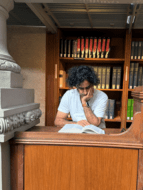
Bruce Crown is from Toronto. He is an alumnus of the University of Toronto and the University of Copenhagen. He is the author of four novels, available wherever books are sold, and has served as the editor of the Hart House Review. He splits his time between Copenhagen and Toronto. // bluesky: @brucecrown // instagram & threads: @wittyoutlaw // brucecrown.ca //