
ISSUE 13.2
SPRING 2026
welcome
issue contents
> fiction
> nonfiction
> poetry
> art
contributors
interviews
our editors
Kevin Bain
The Groucho Debacle
Looking back at third grade, I should have had a harder time buying cigars. But once you tell the clerk at the convenience store that you’re trying to be Groucho Marx for Halloween, they believe you and they sell you a cigar. There isn’t a child in the world, their logic must have gone, who would make up something so specific and weird if it wasn’t absolutely true. I sometimes fantasize about what else I could’ve bought if only I had the dated references to justify them. With a properly placed Great Gatsby reference, I could’ve secured a bottle of prohibition era hooch.
“Leave the wrapper on,” she called after me on my way out, her graying blonde ponytail hanging over the counter.
She had no way of knowing I actually did plan to dress as Groucho that year for Halloween. She didn’t know that I had parental consent to buy cigars, that I watched fifties sitcoms on Nick at Nite to put myself to sleep, or that my parents adored my love of Old Hollywood. This clerk was in her forties and likely thought I was there to buy blunt wraps for some parent.
Lacking awareness or care for her motivations, I biked home and read the packaging on the cigars I’d bought. The first thing I noticed was that they were not cigars, but cigarillos. Some brand called a Swisher Sweet, whatever the hell that meant. I decided that the clerk must have made a mistake and handed me the extra-fancy cigars because she was so surprised. It stood to reason they would be fancier, what with the extra letters in the name of the product.
“Cigar-illo.”
Not only were there extra letters, but this tobacco was sweetened, an added value for sure.
Then, I reasoned to myself, why wouldn’t I get something this fancy for a costume so classy? After all, the moment I told the White Hen Clerk I was a third grader going to Halloween as Groucho, she immediately thought Swisher Sweets were the proper call. I felt sophisticated just holding the package. I might leave them sealed after all, I thought, the better for their value to appreciate over time. I was making an investment. It felt very adult to me, and prudent too.
My goal in dressing up as Groucho was to make friends. I thought it would be a hit. I had just moved on from needing an eye patch every day, but nobody forgot I was “that kid.” It’s almost impossible to recover, in a cohort of public school kids, to shake an early-set perception. Even after the patch and experimental glasses came off, nobody forgot. How could they? I was the first disabled kid most of them met. I was branded into their brains as something “other.”
Rather than become embittered, I opted to win them over. I wanted to hang out with these kids, not to isolate myself. And I would use, as my tool of social seduction, the likeness of a depression-era Vaudeville comedian. If there was a computational logic to how this would win friends and influence people, I don’t remember it.
I didn’t know it at the time, but I was lucky for the fact that Dad was only five feet and five inches tall. Had he been closer to an imposing size, his clothes wouldn’t have even occurred to us as a costume choice. But Mom, seeing that my budget called for a waistcoat and tails, was more than willing to point out Dad’s very literal shortcomings if it saved them a few hundred dollars in dapper young men’s tailoring departments. Deciding that I couldn’t wait for him to get home and give me permission, I ran to Dad’s closet and started shopping through my wardrobe options.
I set about picking the pieces of Dad’s suits that I would need for my costume, and first among them was a suit jacket. It was still too long of course, the coat being Dad-sized. Moving on to the next piece in my ensemble, I bellied-up to the hanger that held Dad’s improperly folded ties on a single plastic crossbar. Dad was a paisley guy, evidently. Paisley was a dealbreaker. I was dressing as Groucho Marx; I couldn’t show up looking like some weirdo. I found the one and only black tie, too long for both Dad and I but perfect for comic effect. I had everything I needed now.
I just had to try the whole costume on. Gathering up my ill-gotten costume goods, I ran to my bedroom, smudged a clumsy thumb of obsidian grease paint across each eyebrow, then across my upper lip to recreate a classic Groucho mustache. I popped my wire-rimmed glasses atop the bridge of my nose and stood back, popped a still-wrapped Swisher Sweet between my teeth, and went to the bathroom mirror to take myself in. The look was complete.
The garage door loudly rumbled open. Since my big brother Kyle usually chose a stealthier means of entrance (the better with which to ambush me), that meant Mom or Dad were home. Pleased to see my Halloween plan coming to fruition, and eager to show it off for their approval, I shambled down our ranch-house hallway into our eighties shagged dining room and waited for whichever parent it was to see how I looked. It was Mom.
I couldn’t contain my excitement and showed off my new costume. After knocking down a couple of tailoring suggestions with some very reasonable arguments, Mom was just as excited as I was. We spent the hour she usually spent cooking us dinner to brainstorm ways I could play up the Groucho bits. I practiced eyebrow gymnastics, cigar-wiggling, and canned Vaudevillian wit. Not to toot my own horn, but as far as amateur child impressionists of dust-bowl era comedians go, I was good. So giddy was my mother that she told me to go next-door, to her best friend Alice’s house, to show her.
Alice answered her front door clad in a seafoam bathrobe. Her hair was freshly done in her evergreen perm, with makeup more recently-applied than my own. David Bowie’s “Space Oddity” played from her stereo so loudly I couldn’t hear her, but the delightful squealing she let out needed no audio. Alice waved me inside to get a better look, and I schticked-up a hammy little step through the threshold of the door, to Alice’s delight. She crossed to her stereo and turned it down, making her vocally-fried giggles audible. She stood back to soak in the costume, grinning ear to ear.
“How the fuck do you even know who Groucho Marx is?” Alice asked, thinking nothing of the four-letter word to a nine year-old boy.
I had to think. My introduction to Groucho Marx came from a combination of places.
My first explicit introduction was a practical joke shop, a now-defunct little store called Magique in Roselle, Illinois. They sold any number of practical-joke delinquencies for a bored little brother to get into, one of which was a classic nose-and-glasses disguise kit. It was the exact kind Bugs Bunny would wear when roasting Elmer Fudd, and so obviously I just had to spend a week’s allowance on it. Six dollars later, it was mine. That’s when I read the receipt on my purchase, and asked my parents why it was called a “Groucho disguise.”
This is when Mom, apparently a huge fan of Groucho Marx, took her opportunity to transfer all knowledge of the Marx Brothers into my fertile brain. She showed me films like Duck Soup and A Night At The Opera. She’d call me into the room to watch infomercials advertising a VHS box set of You Bet Your Life, Groucho’s mid-twentieth century game show. Mom’s youngest son loved something that she grew up with, and it elevated her mood skyward. Dad encouraged it too, of course, but Mom was the one who gave me permission to buy tobacco.
“Mom,” I answered Alice, deciding not to include any backstory about Magique or Bugs Bunny.
“Do you know any Groucho jokes?” she pressed.
I should have chosen a nicer joke to show off.
“Ahh, Alice, I can just picture you at home, bending over a hot stove,” I began, innocently enough. She wasn’t impressed but she was being polite, and squeezed a tiny squee. Then I continued.
“Only now I can’t see the stove.”
Alice, having apparently forgotten that Groucho was a roast comedian, was as surprised as she was bemused at my giant-ass joke. I wiggled my eyebrows and cigar as uproarious laughter came from a room down the hall. Her husband, a greying man in his forties named Bill, had been listening in quietly and couldn’t maintain his silence any longer. A shit-eating grin creased my lips and eyes.
Any doubt that Alice knew my middle name was removed, because she must have used it five times when dressing me down for my insult. I had just offended Mom’s best friend with a well-timed and memorized wisecrack about her having a big butt, which at the time was against beauty standards. She was mad. Bill was entertained. I was in trouble. It was perfect.
The day of Halloween, I learned a number of things. I learned that nobody else had parents who gave a flying rat’s ass about Groucho Marx, and never passed that love on as my own mother had. I learned that none of the other kids I went to school with had an iota of curiosity regarding the man whose goofy face donned our favorite cartoon characters in disguise. I learned that older people love watching the youth continue the entertainment traditions of their youths. But mostly, I learned that failure doesn’t look like failure when you’re in the middle of it.
The first form my Halloween failure took was one of over-anticipation. I was one of four to five kids in my class of over twenty who dressed up at all. If there’s one thing worse than being one of only a few people in-costume on Halloween, it’s being dressed in an anachronistic costume that would better blend-into a more varied and technicolored ensemble of similarly ridiculous-looking youngsters. Having no such luck, and being one of only a few in costume, I only stuck out like a sore thumb even more so. I felt the sideways eyes of classmates weighing heavy on me, threatening mockery that never quite surfaced. Somehow, their barely-concealed sneers and formica-deep smiles were worse than the open bullying I dreaded.
When I arrived at recess, I found that failure has another form. Every other kid dressed in costume was something you could distinguish from a mile away: witches, kitties, and Ninja Turtles dotted the playground. And I noticed that none of their costumes needed an explanation, something I was forced to repeat multiple times that day just to move beyond the baffled and confused stares of peers both younger and older. Failure, in this case, looked a lot like lecturing classmates about the golden age of television and talkies. I did bits and jokes from Duck Soup, and even told the same “hot stove/fat ass” joke that killed at Alice’s house. It bombed. Even some of the school staff, adults who knew of Groucho, were more concerned with how I’d gotten a hold of real tobacco. In this case, failure was in over-trying.
Failure has this way of looking like the same thing you already deal with on a daily basis, looking like the absence of some idealized boon that never materialized, “the one that got away.” Nobody talked to me any more or any less than before. I didn’t get hit, I didn’t get hugged. I didn’t get a big epiphany that I didn’t achieve my goal, there was no gameshow buzzer in the sky to alert me. I went to school, I went home, I repeated. So no, I didn’t get a big sign that I failed. Not until much later.
The following Spring, a classmate named Adam had a birthday party, and everyone was invited. Adam was the popular kid in class. He was tall, athletic, funny, well-liked, and his mom volunteered to chaperone us on every field trip. He threw the best parties, and everybody knew it. Our teacher, a kindly woman with fire-engine hair named Mrs. O’Hannes, didn’t even mind when he interrupted class for a joke. Girls wanted to call him; boys wanted to play little league with him. I did too. We all did. When his birthday came that year, he handed out his invitations one by one. He skipped over my desk, and only my desk, then laughed to a few classmates. I was the only kid in class not invited to his birthday party. It probably wasn’t because of the Groucho costume, to be honest. But this meant my attempt probably made me even less likable than before. Adam is how I truly felt that failure.
I didn’t cry. Not at school. Not on the bus. Not when watching Tiny Toon Adventures instead of doing homework.
When Mom came home, she knew right away something was wrong. She asked what happened, and that’s when I finally bawled into her arms and told her what happened. The first thing I felt was tension. Mom was mad, and I prepared for it. Then, her tension fell. Softened.
She curled her arms tighter around me, holding me with the thrumming intensity of a mother’s willful comfort. I expected rage and indignation, a fight to the death to ensure I would be invited to a party that the guest of honor didn’t want me to attend. Instead she just held me, told me she was sorry that anyone did such a terrible thing. Not content to let me wallow, Mom led me to the kitchen where I helped her cook dinner, mostly by staying out of her way.
That Friday, Mom arrived home with a movie she’d rented from Blockbuster Video. It was called Rear Window, and Mom told me it was directed by the same Alfred Hitchcock whose old TV show I was already watching on Nick at Nite. Kyle and I watched, together with Mom and Dad, scared witless at the murderous Raymond Burr and his stalking of poor Jimmy Stewart.
The next Friday night, we watched a documentary about Groucho himself and capped it off with another Hitchcock oldie, Dial M For Murder. Kyle, normally a tormentor, sat next to me as we soaked in the suspense. Dad took extra time at bed to tuck me during these nights. Mom spent the next few weeks close, making sure that I knew I would not be judged or outcast at home for loving what I love.
She did, however, confiscate my cigarillos.

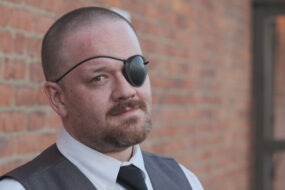
Kevin Bain is a memoir writer and script reader whose work has been featured in The Argyle and Halfway Down The Stairs literary journals. Originally from Chicagoland, he now resides outside Cleveland with his wife and their loving menagerie of cats.