
ISSUE 13.1
FALL 2025
welcome
issue contents
> fiction
> nonfiction
> poetry
> art
contributors
interviews
our editors
Skye Ayla Mallac
Betwixt and Between
“Hello, Skye Pie.”
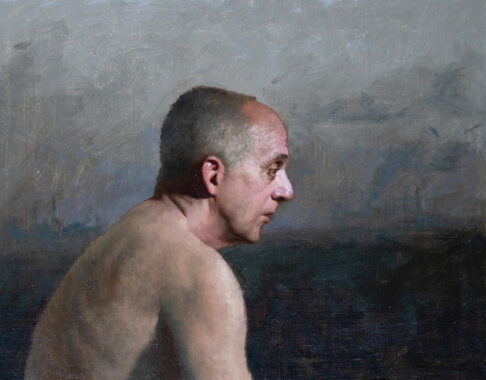
Blue eyes blink open from within a hollowed face. Bone clinging to skin, stubble coarse and shadowy. Beneath the covers his deflated form is barely a hump. He is shrunken and tiny, dissolving as the days go by. But his eyes are his, and when they open, searing in the winter light, he’s there.
“Hello, Grandad.”
I found out about the cancer from my mother’s emails. There was a time when I was complacently nosy when it came to her correspondence. Perhaps my life didn’t feel as interesting, or maybe I wanted to be included in the nuances of an existence beyond mine. But I simply felt at liberty to rifle through her life. It takes us a while to accept that our parents are separate from us. So I found the email and then pretended I never saw it when she told me.
It felt like a chill revelation. I always knew my grandfather would be the first to go. Some sort of logical conclusion I had drawn down the family tree, eldest to youngest. It was a natural, if unnecessary, awareness I skirted around, with avoidant acceptance of something I did not have to face yet. But suddenly that distant future was inching nearer, slipping into my periphery, and I could only look directly at it.
I like to think I don’t have too much time for regret. But I do regret leaving when I did. Febrile and headstrong, caught up in a whirlwind of self-indulgent existentialism, I left halfway through our annual family holiday, boarded a flight and let it slingshot me 12,000 kilometers across the sea.
When COVID hit, a month later, he was characteristically insouciant. He waved off my telephoned concerns with mutters of “What nonsense,” and segued the conversation back to me, where I was trapped in Costa Rica as the iron curtains of the world slammed down between us.
When my mother drove to Johannesburg to care for him, I was succumbing to daily panic attacks in the jungle as I wrestled with embassy officials over the phone.
“Stay where you are if you can, please,” was the perpetual reply, and I read stories of my compatriots stranded for weeks in airports. But I was fevered and wild and desperate to get home, to unravel that knot of regret, to get there before he left.
Suspended in the amniotic waters of the Caribbean Sea, I tethered myself to him in his sleep, a last-ditch attempt at spiritual credence. “I’m coming, I’m coming.”
The journey home, when it came, felt like picking a lock on door after door, praying the next would open. I slipped through the cracks, paced boarded-up city streets and empty airport halls, tumbled back into my country in the early hours. I was bundled into a hotel room. Thirteen days, an empty courtyard, four knocks on my door (breakfast, lunch, symptom check, dinner), fifteen minutes to pace the grounds.
But when they release me back into the world, he is still here. He looks so small in bed. “Hello, Skye Pie.” And he tips his cheek for a kiss.
A small routine unfolds, suspended in a limbo of his undefined remaining time. The days are slow and uneventful, unspooling and stretching with an elastic-like cadence. I make cups of tea. Dark, rich Ceylon, steeped too long so the astringency dries the tip of my tongue. I don’t trust the city streets, so I jog up and down the stairs, do yoga once the sunlight finds my bedroom floor. My crochet project looks like a puddle of the ocean, pooled on the corner of the bed.
He is still walking when I arrive. Then his knees collide with the paving outside his bedroom door. He was impatient to leave the confines of the space, my mother was cooking eggs in the kitchen, there was a step down that he couldn’t quite catch. My mother blames herself, but she shouldn’t. She is wholly devoted to the task of caring for him, while his wife pours brandy and is asleep by 3 p.m.
There are no consistencies. He eschews food and then wolfs down a bowl of berries in minutes. While he is still lucid, he is desperately frustrated at his condition. He refuses to admit—or rather, cannot fathom—the extent of his illness. He forces his body out of bed, insists we go out for a fast-food breakfast, but he barely makes it across the parking lot and we leave early, packing breakfast into cardboard boxes.
When bed claims his world, he slips away and returns, once, twice. We wonder if these are the final days, and then the film reel seems to pause, and more time is dished out and we leap upon it.
The first time, he sleeps for three days, cheeks flushed. My mother curls into bed beside him, and Van Morrison’s “Have I Told You Lately” issues from her phone. It is a love letter from her sister, my aunt, who is not here. We wonder if this is it, barely sleeping, ears trained for sound, and then, on the third day, his bright blue eyes pop open, a smile stretches his cracked lips, and he is back.
As the weeks unfurl, he starts to struggle in telling the difference between the three of us: his wife, his daughter, his granddaughter. I have never watched death close up before. From this microscopic vantage point it’s an obscure unravelling, a shrinking, a Benjamin Buttoning as he slips from adult to child.
It’s a backwards birth.
His hospice nurse, who visits weekly, recommends a book to us. It’s about dying and what to expect. And I’m grateful because it allows the latent anxiety to lift a little. His wife stops trying to convince him to eat, and when he starts to slip into daydreams, we allow his reality to wash over us.
My grandfather built his business from the ground up over forty years. He sold the company and bought it back. He took little leave and splurged only on his cigars which he puffed as he poured over his work into the evening. His dining room table was unfailingly strewn with papers. Spectacles perched on the tip of his nose as he punched numbers into a palm-sized calculator. I don’t ever remember eating at that table except at Christmas.
Now he’s anxious and restless, convinced some pressing meeting is imminent, some large and complicated claim must be processed at his insurance brokership. He insists we take dictation, apologizing for his tardiness, explaining the context of his issues at large. He instructs my mother to lay out his suit for a meeting and then falls asleep.
I walk in one afternoon as the winter sun spills across the bedroom and he’s sitting, propped against the pillows, his brow furrowed in obvious vexation at his own ineptitude.
“How’s it going, Grandad?” I ask, offering him his glass of water. He takes a tiny sip and passes it back, distractedly. “I’m just sitting, trying to create a positive vibe,” he sighs.
But when this frustration and the increasing dizzy spells get the better of him, he retreats into himself.
“I’ve been up to all sorts,” he tells my mom in delight one morning as she arranges his inordinate stack of pillows. He proceeds to reel out his excursions, the meals he’s cooked, baths he’s taken, the shoes he left behind on a trip to the coast.
Later I poke my head around the corner to find him just about falling off the bed, arm outstretched in an attempt to retrieve something. He glances up and sees me.
“I dropped my cigar,” he explains, still stretching a hand towards the empty floor. I crouch quickly and pick up air.
“I’m just going to put it here, Grandad,” I say, placing the invisible cheroot on the far side of the nightstand. He nods and closes his eyes.
As he slips further and further, he spends more time shifting between worlds than consistently in one. When he returns to our world, not the one which is so clear to him, he takes time to reacquaint himself. It’s easier, I think, to remain within the freedom of his dreams.
But they aren’t just dreams. There’s something more to the world he slips away to. Sometimes he returns distressed, forcing himself back to reality with what feels like stubborn fear. Peace and anxiety trade places inconsistently. Sometimes he closes his eyes with a promise to come back, other times his brow furrows deeply, face creasing into lines of misery at whatever he has found in that mysterious place he goes to.
“I’m betwixt and between,” he says one day, eyes opening slowly, staring up at us from his cloud of pillows.
I am alone with him one afternoon when he squirms in bed, restless, anxious. His eyes find mine and I’m not sure he recognises me.
“Wee, I need a wee,” he says hoarsely. I feel my stomach lurch. While the unspoken boundaries held when he was healthy, when I was young, have slowly been rubbed away, I have never helped him relieve himself.
A blue medical bottle is tucked beside the bed. My mother is out, my step-gran is asleep.
“Okay, okay,” I say as he squirms again, tugging at the waistband of his long johns. I help him pull them down.
His penis is shrunken and flaccid, and he doesn’t flinch when I peel it from his hip and tuck it into the mouth of the bottle. This illness has stripped any ignominy from this bizarre moment, but at the same time my mind reels and I marvel at how this intimate appendage, which fathered my mother, which symbolises his manhood, could be such a deflated and useless thing in the end.
The last days are soaked in a bizarre unspooling of time. His wife gives him a sleeping pill without telling us and he vanishes, deep into himself, surfacing only in an intermittent terror. Eyes wide, arms outstretched reaching for something, pulling himself from this place that wants him to remain there.
Any final boundaries between us are erased and I sit steadfast at his bedside, stroking the hair back from his forehead. It feels like stroking bone, so little flesh still clinging to his form. “It’s OK, it’s OK, I’m here,” I whisper as he gasps, eyes wide and staring up at something I cannot see. “Shhhhh…”
He settles and his eyes close, but his fingers hold my own tightly. A moment of peace before the next shock. He pulls himself from it again and again, terrified, determined to remain.
“Hold me, hold me!”
The words are forced from his parched throat. He has barely spoken in days, but his voice is clear suddenly. I bend at the waist and wrap my arms around his shrunken frame, and he clings to me as his body shakes.
The following evening, he is peaceful again, breathing deep, so near and yet so far from us. Not quite gone. I adjust his clothing and catch a glimpse of his body. Chest concave, belly sunken. So little of him left. And it feels cruel, that he should prevail, through this dreadful discomfort. It would be better if he leaves now, allowing the wisp of him to depart.
The day he passed was still. And peaceful. And warm. It was like everything slowed down to commemorate his life. The house was quiet. His garden was green—a blooming early spring, pulling buds and blossoms forth. I went in to look at him, before the funeral home came. I know that everyone says this, but he looked like he was sleeping. I could almost see the rise and fall of his chest if I let myself believe it. My mother kissed his cheek on my behalf. It was cold by then, and she didn’t want it to scare me.
She had drawn him, coaxing his face in its death from the tip of her pencil. She told me she had cried and washed his feet with her tears.
The world was so still. Not a breeze.


Skye Ayla Mallac is a South African writer, poet and creative. She has worked as a freelance writer for over a decade. Her debut poetry anthology Whole, Gold, Crystalline was published in 2022 through One Mountain Press, and her debut novel The Bee People was published on AmazonKindle in 2025. Her work has appeared in the FicSci 02 anthology night_sky, Ubuntu Magazine, The Argyle Literary Magazine, and Schumacher Magazine. She is deeply inspired by the intricacies of her own psyche, the exploration of vulnerability, and the South African landscapes she grew up in.