
CONTRIBUTOR SPOTLIGHT:
Interview with Alexandra Bergmann
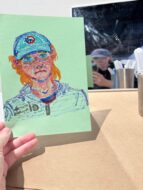
Rappahannock Review Interview Editor: There is a central theme of relationships found in “Traces,” with the narrator seeing someone they care about in places they visited together. What made you center the poem around this idea?
Alexandra Bergmann: I say the phrase wherever you go, there you are to myself all the time––mostly as an admonishment for thinking that any transition (geographic, educational, professional, or otherwise) will transform me into a new person. It feels silly at this point to even believe that I could abandon the old me––or the me me, the hopeless romantic me that I keep finding to be me––so easily, but I wander on.
This poem started as an ekphrastic response to “Never Let Me Go” by Jeni Follman, but it failed in a way most of my ekphrases do: Reading my earliest draft, I realized that I wasn’t responding to the painting in any meaningful way, but instead, I was responding to my own emotional experience of the painting. I couldn’t take myself out of the picture, as it were, but that last image––the woman over the dunes––is a vestige of my attempt to capture something in Follman’s artwork. In it, I saw a phantom that I carry around. Rather, I saw that ability to see phantoms in everything. All that haunts me––heartaches, in particular––makes me, and wherever I go, there I am.
RR: All of the lines up to the last two rhyme with each other. Why did you craft that couplet in this way?
AB: I’m kind of a sonnet coward. I love them, but I’m afraid to fully commit to the form for fourteen lines. I fool around, trying to get away with American sonnets bursting at the gills with sonic clusters. The first eight lines do have that same terminal consonant rhyme, sibilance choked off by the stop of the t in all but chorus, but they also follow ABBAABBA. So here I am, on the precipice of actually writing a Petrarchan sonnet to completion, when I back off. The rhyme switches, and so we have our volta, but the narrator has two turns in the couplet: the briefest look toward forgetting and the last look toward remembering. That tension of brevity and finality is key to me––and the reason why I had to write a couplet instead of a sestet. There’s that tantalizing peace peeking out just when the curtain’s about to close. Then there’s the hero failing on the threshold.
RR: There is a moment at the end where the narrator seems to find peace, only for it to be taken away again. Why did you choose to end this way?
AB: My glib answer is to keep things spicy. Really, the problem is this: the narrator can move all they want, but they cannot move on. “Almost” is the door. You almost / see the sea for what it is. There’s the possibility of peace, if only the narrator would actually walk through the door to reach it. But why would they walk through for only a possibility––when the face of grief is so familiar and has such a certain shape?
RR: While you have an MFA, you are also a scientist. Do you find there is any connection between poetry and science?
AB: Of course! Anything can be poetic subject matter and I can turn a scientific eye to anything. More than that, poetry and science are both methods of observation, investigation, explanation, and contemplation.
Too often, the “science” that exists in the public imagination is a static body of knowledge, but really, science is a process. As much as scientific topics inspire my poems, I more consider myself a “science poet” in the sense that I want to scientifically engage in the process of poetry. I want to understand the craft at a technical level. I want to test and modify and test again. I want to apply pressure to language until it breaks––then magnify the pieces.
RR: What is one location you can go to that brings you peace?
AB: There’s a hilltop I’ve run to for years now that grants me the bliss of escaping myself. Buckeyes, coast live oaks, and eucalyptus trees line the trail. Acorn woodpeckers flash the white of their wings between their barky apartment complexes. Anna’s hummingbirds J- dive down 100 feet to court their damsels. Red-shouldered hawks hide easily in the canopy. It’s the one place I’ve taken a decent photo of a Western Tiger Swallowtail. From an always empty bench, I watch the seasons change in the grasses growing on other hills. Soon, should there be enough rain, they shall be green. There’s so much to see outside of me.